Today,
Sunday 3rd January, I posted some information notices on each of the
seats beside the gravel track. [These are now uploaded below, following a note
about the benefits Mt Rogers’ carers gain by being on Mt Rogers.]
The
notices on the seats might have been more use 1-2 weeks ago as Mt Rogers has
hosted many newcomers over this holiday period.
The idea is that each piece may help passers-by pause, observe and
ponder the scenes and sights we see every time we’re there.
As
our community is so observant, curious and alert to changes each time we walk
and exercise there much of what I’ve drawn together will be common knowledge to
you….but let’s hope more people are encouraged to learn and benefit from Mt
Rogers’ magic this year.
Several
times a week we may find we need willpower to make those first steps on the
ascending path to Mt Rogers or to the garage to have the car help us up the
challenging ascent. Some of us also have
pleading or demanding brown eyes to spur us on. I think, universally, we daily
appreciate the benefits of exercise for our bodies (aging or fit) and minds
already brim-full of contemporary clutter as well as valuable information.
We
have the gravel path to walk on. Even the repaired surfaces teach us to be
alert, to watch where we tread, to adjust to differences in levels and the
changing but mostly gently undulations. Even the still-rough section east from
the Notice box has value as extra care is needed to negotiate the protruding
rocks, wash-aways, loose stones and silt collections.
Additionally
we learn here how the effects of thousands of feet, hundreds of wheels, many
paws and moving water loosen soil, grit and gravel to illustrate how erosion
happens. In winter we’ve noticed that the mature caterpillars of the Pasture Day
Moth dig out tunnels for their pupation in this harsh surface. I once had a
20-something young man denouncing the government for not concreting the path.
Obviously he didn’t appreciate that the current path made ‘walking in the bush’
feasible for many and was better than nothing for many others. Dogs have made
their own softer-on-paws grassy path in places.
We
can ‘go bush’ if we wish (and are suitably shod and equipped) by taking one of
the many tracks and paths up towards the ridgeline or the summit. From these
dirt tracks our chances of seeing more wildlife and more native plants are
enhanced. But we learn about seeds in dogs’ ears and coats, the increased
possibilities of snake encounters in the warmer months and the chances that our
canines might dash off after the irresistible challenge of the kangaroo mob’s
presence.
The
Frogmouths nesting in their big tree tolerated our learning about them, birds’
behaviour and how to be observant with or without binoculars and cameras. Mt
Rogers folk know that each species of bird has its own suite of calls. We know
a fair bit about the relationships between bird species and which vegetation
level is their preferred feeding zone.
Alarm calls cause us to look skywards in case there’s a raptor on the
prowl or looking out for prey. There are places to check for Butcherbirds,
Kookaburras, Sparrows, Magpie and Currawong nests. Superb Parrots have put us
on the ACT’s ornithological map again this year as they seek out gardens’
unharvested fruit. [Two ornithologists, Geoffrey Dabb including photo, and Dennis, posted these two notes:
Paid a quick
visit this morning. Apart from being the ACT’s dog-walking capital, the
periphery of Mount Rogers is well equipped with fruit trees, which at 3 points
were getting the attention of the parrots. As the cherry growers of Young know
well, this species likes a bit of fruit, probably a source of moisture in dry
weather too. Like lorikeets, they seem to express the juice between
tongue and bill.

&
During our regular circumnavigation of Mt Rogers this morning I saw dozens of superb parrots including many youngsters in the green space to the south of the Wickens Place carpark and to the east of the well-named Bird Place in Flynn. Lots of short flights accompanied by calling mostly in what I assume to be family parties of three individuals. Worth a look if you are in the area, particularly in the mornings. ]
During our regular circumnavigation of Mt Rogers this morning I saw dozens of superb parrots including many youngsters in the green space to the south of the Wickens Place carpark and to the east of the well-named Bird Place in Flynn. Lots of short flights accompanied by calling mostly in what I assume to be family parties of three individuals. Worth a look if you are in the area, particularly in the mornings. ]
Honeyeaters chatter amongst successive flowerings of
eucalypt species and we’ve noticed the infiltration of Rainbow Lorikeets. Channel-Billed
Cuckoos have been sighted & heard this summer in Fraser. They’re
fruit-eaters also but will cuckold Magpies and Currawongs…maybe they need to
arrive earlier than November for this in coming years.
In
conversation today we touched on the value of carrying a mobile phone. We’re
able to alert ACTEW to water or possible electricity problems. Mobiles can help
when people tumble & calling their emergency contacts is needed. The Pet
Ambulance operating from near Kippax
6254 1866 or 0448 789 039 could mean a dog reaches an anti-venom injection at a
vet’s in time. And there’s Access Canberra
13 22 81 for reporting incidents, fallen branches & dumping for
example. Most people carry drinking water these days so that’s an improvement.
Because so many of us have learned about
dogs’ behaviour and appreciate dogs’ need for natural exercise and socialising
we’ve increasingly valued the companionship of pets, even when we’re not owners
ourselves. We know that at times, even with training, dogs’ responses to instinct
can be stronger than owners’ control. Some people are upset by uncleared
dog-poo. Let’s hope the provision of bins for poo bags will clean up the place.
We need to ask for this again, and for signs that inform newcomers of Mt Rogers’
Dogs off Leash status so they can choose whether or not to walk here. Please
email Helen.GombarMillyn@act.gov.au
asking for bins & dog status signs.
Evidence of the development of our
community couldn’t have been stronger as we submitted against Mt Rogers losing
its Dogs off Leash status. This is our example of communities coming together
to protect what they love and their freedoms. The Land’s stewards protect what
they value and what society needs for survival. Don’t we need to also put
ourselves in others’ shoes and support those whose farms, communities and
nature reserves are being threatened by coal expansion and CSG fracking?
There’s a photo posted reading NO SANE CIVILISATION POISONS THEIR OWN WATER
SUPPLY: STOP FRACKING NOW.
As we walk round Mt Rogers the open
space and fresh air give us time to be ourselves. We make time for letting our
thoughts wander. Perhaps our minds can wander away from pressing issues at home
or in our networks. Perhaps we can harmlessly prioritise ourselves for a while,
delete a few unnecessary files in our brains or allow stimuli from what’s
around us to take us towards new thoughts, solutions or back amongst refreshing
memories.
There are chances to touch base with
fellow walkers from time to time or as part of regular arrangements. Surely in
our lives we need both situations: time to ourselves and time shared with
others through conversations, camaraderie, by Skype or phone-calls. Mt Rogers
conversations have taught many of us that we share the reserve’s space and
similar ideas on a range of topics and issues. Our patch is a treasure in the
rush of contemporary life. If only we could ensure that quantifying Mt Rogers’
value appears in budget balance sheets ensuring there are sufficient funds for
caring for the region’s habitats.
Whilst we slow down to take in Mt
Roger’s qualities and nature we learn so much. Not all eucalypts are the same.
They and wattles alternate their flowering times to provide nectar and other
pollinating inducements throughout the year. There’s diversity in barks’
colours, textures and lichen coverings for artists and photographers to
capture. In the photo here, as Frances and Margaret stride past, I
tried a shot of these markings on a small eucalypt. Extraordinary excretions from insects to create their 'homes'...made
delicate patterns, discovered by chance.

We slow down to absorb seasonal changes and the weather’s increasing variations. Clouds are an endless fascination especially when the various layers and wind-speeds are taken into consideration. Can we imagine shapes in the clouds as we may have done as children? De-stressing is good for us all and Mt Rogers offers this, beyond holiday periods, every time and in all weathers.

We slow down to absorb seasonal changes and the weather’s increasing variations. Clouds are an endless fascination especially when the various layers and wind-speeds are taken into consideration. Can we imagine shapes in the clouds as we may have done as children? De-stressing is good for us all and Mt Rogers offers this, beyond holiday periods, every time and in all weathers.
As part
of the information notices on the seats I have included this photo.
 It shows what Mt Rogers was like in the seventies
as Flynn houses were being built. The power poles were already in place as were
the reservoirs. Decades of grazing had taken out any shrubs or trees that might
have regenerated or germinated. Only the majestic old, naturally occurring
eucalypts remained. The grass looks much as it does in January 2016: waist high
in places and dried beige. Do you know of anyone who might have photos from
those early days, from when your house was built and of the views that then
existed? Perhaps we could collect
more copies and have a yesteryear display at some point before all these photos
end up forgotten in cupboards. Please
let me know if you’re interested in helping with your photos. 6259 4724.
It shows what Mt Rogers was like in the seventies
as Flynn houses were being built. The power poles were already in place as were
the reservoirs. Decades of grazing had taken out any shrubs or trees that might
have regenerated or germinated. Only the majestic old, naturally occurring
eucalypts remained. The grass looks much as it does in January 2016: waist high
in places and dried beige. Do you know of anyone who might have photos from
those early days, from when your house was built and of the views that then
existed? Perhaps we could collect
more copies and have a yesteryear display at some point before all these photos
end up forgotten in cupboards. Please
let me know if you’re interested in helping with your photos. 6259 4724.

If
new people move into your street take a Mt Rogers brochure for them after you
judge the main unpacking has been done. There’s also the Explore listing available.
It gives options for visits to may other parks and playgrounds and is evidence
of your rates being interestingly spent on encouraging outdoor activity.
Rosemary,
Convenor, Mt Rogers Landcare Group.
....................
Hi Mt Rogers Carers
Here's a few thoughts on how we benefit from Mt Rogers.
There are also some wonderful actual examples of rewards that have
nothing to do with money:
Margaret & Chris tackled some Verbascum flower-spikes in their own
time as Working-bee volunteers. By chance were able to show them an enormous
caterpillar that confirmed similarity to one they'd seen closer to home. Try
searching on Chelepteryx collesi or White -Stemmed Gum Moth and add 'images'. I
mentioned them on the COG (Ornithologists') email line and had several
responses that included fabulous photographs of the caterpillars, cocoons and
the emerged moth. Peter came across one of the caterpillars earlier and just
before I'd found a dead one in Flynn. Avoid handling the caterpillars as the
spines can irritate. A rather beautiful painting of them is online at
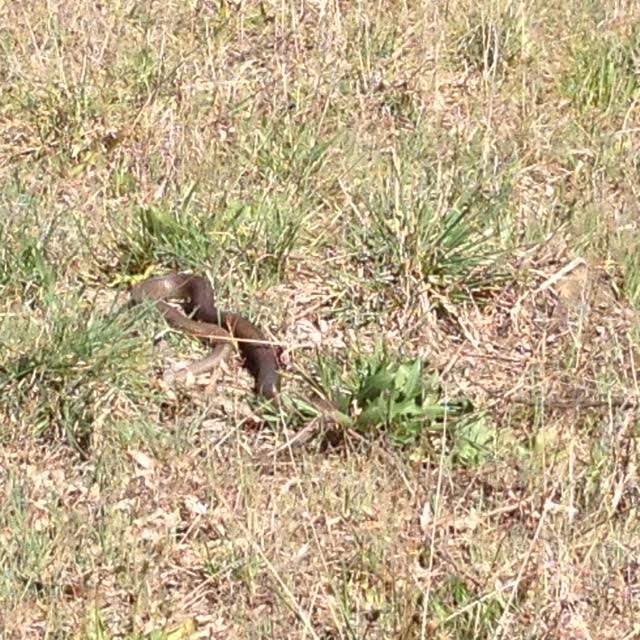
In September Frances photographed an early-active Brown snake. Ian has
provided a classic shot of a Brown snake working out how to devour a large
lizard. Sad about what seems to be an Eastern Dragon lizard...Which reminds
me Snakes Alive is on again at the Botanic Gardens from 18th
to 24th January. There's a modest entry cost by which The
ACT Herpetological Association raises money for reptile & frog research.
(And there's parking costs where the funds help the Gardens projects &
don't go into ACT government coffers).
The Schwarz Place Frogmouths have spend some days recently roosting in
the Flynn garden's backyard trees.
The Superb Parrots have really been a feature of Mt Rogers over the
holiday period. The begging calls of the young alert us to their presence.
There have been many sightings on the reserve's edges where gardens have
unharvested fruit trees. Several people have remarked on how difficult
they are to see even when we 'know' they are in a certain tree.
Koels are even harden to find even when it's clear where their
"Ko...elle" or "Wirra Wirra" calls are coming from. The COG
line has had photos of Koel chicks hiding in foliage but being fed by
Wattlebird parents.
Kookaburra have been attracting interest and delighting their fans but
has anyone seen any Sacred Kingfishers this sprummer season?
The sporadic rain we've have has enhanced the browns & beiges of
trees' bark and shown where the rainwater runs down trunks & into the soil.
It takes a while for rain to penetrate through the trees' leaves to the ground.
It's probably even longer before rain penetrates the mulches we've dutifully
used on our gardens. Coarser mulches let the rainwater through more quickly and
allow air to reach the soil. Let's hope most people have watering systems under
their mulches so that less water is lost to evaporation.
There's several tree species around Flynn whose bark is peeling off as a
result of the heat and now the rain. The bark can be used as a loose mulch as
it's brittle enough to break or crush into smaller pieces to cover open spaces.
It's possible that the eucalyptus oils & chemicals inhibit weed growth but
some seeds inevitably blow in from the neighbourhood.
It's almost time for Crepe Myrtles to be flowering and showing why
introduced plants appeal to gardeners. I've noticed several privets around the
place having a renewed burst of flowering. Their creamy yellow flowers will be
followed by navy-blue berries and they'll keep hundreds of Currawongs happy.
How many of the berries will end up on Mt Rogers for the Landcare Group to
tackle in 2017 and beyond?
It's been great to meet new people whilst walking round the track
recently. Thank you for joining the e-list.
There may be others on our list who wish to 'unsubscribe'. If that's so
please just let me know in an email.
Hopefully I'll have some of the moth and snake photos up on the mtrogerslandcare.blogspot.com later
in the month...thanks to Ann.
Enjoy any remaining holiday sharing with family and friends and the
relaxing Mt Rogers brings,
And thank you all for your multi-faceted support for Mt Rogers!
Rosemary, 4 January 2016
......................
The MT ROGERS SEAT notices (8 of them)
AVERY-WOODGER
SEAT: Faces WEST
The
eucalypts here used to benefit from nitrogen from Wattles growing near them.
Many wattles & shrubs in the Fire Abatement Zone have been cleared to
protect homes & infrastructure.
The
bush to the right represents the species that comprise a healthy Grassy
Woodland ecosystem in the ACT region. There’s a mix of ancient eucalypts &
their younger offspring. There are wattles, Cassinias & other shrubs which
provide insect prey, nectar, seeds and shelter for a range of birds through the
seasons.
In
spring there are species of wildflowers that bring blushes of colour to the
ground & leaf-litter.
These
natives are testimony to the extraordinary tenacity of some species & their
seed dispersal methods. They’ve survived 4 decades of being surrounded by very
different garden habitats. Huge changes in soil structure & fire regimes
have altered soil chemistry & consistency.
Birds
from the 80+ Mt Rogers’ species list, including Superb Parrots, Common
Bronzewing Pigeons, Butcherbirds, Honey-eaters regularly visit this quality,
natural woodland remnant.
NOTICE-BOX SEAT: Faces WEST
Views towards the distant Brindabella Ranges & north towards the Wallaroo area in NSW are especially colourful at sunset. Moving clouds indicate influential changes in the weather.
From the 1980’s Dunlop was built into paddocks. It’s no longer possible to see where Ginninderra Creek turns west towards its confluence with the Murrumbidgee.
From here we are able to appreciate the importance of green spaces for connectivity as birds move to and from the ranges in spring and autumn. Suburban trees play their part for migrating birds. Un-harvested fruit is important for some species in summer.
Boulders provide wattles with a refuge from the mowers.
Behind the seat there’s a huge Apple Box, Eucalyptus bridgesiana. It’s surrounded by the natural untidiness of the bush with grasses, wildflowers, shrubs and small trees all contributing to the nutrient-rich leaf-litter of Mt Rogers’ grassy woodland habitats. Beetles, termites, native cockroaches & moth larvae feed on the litter releasing nutrients regardless of leaves having phenols, tannins, oils & toxic chemicals.
The track beside the gum tree shows the effect of rain- water eroding the thin soils and exposing rocks and roots.
Simple run-offs now divert water into the bush to restore the ground-water. Water rushing downhill reaches & erodes the main gravel path affecting all walkers when rocks are exposed.
FRASER-SPENCE
PLAYGROUND VIEW SEAT: Faces NORTH-EAST
At a
5-6 way junction the Blue-metalled track leads up to utilities near the 704m Mt
Rogers summit & right to the reservoirs. 16 cul-de-sacs give access to the
reserve from the 4 suburbs & 6 locked gates for the authorities’ vehicles.
TAMS personnel are the area’s land managers.
Apart
from the gravel track circling the edge of the vegetation there are numerous
informal tracks going cross-country from the main track. Kangaroos make their
own pathways as they graze or move through the woodland sections.
New
kangaroos may be scared up to Mt Rogers via easements
through Flynn and Fraser.
To the
right & on the mown zone there’s an old eucalypt sprouting new vertical
branches after it fell. Behind to the left is an ancient eucalypt that has a
maze of branches & hollows. It’s probably been a vital habitat tree for
birds & arboreal mammals for more than 300 years.
It’s
surrounded by the complexity &, some say, the untidiness of the bush.
Wattles, when dead, still provide shelter from predators for small birds. Under
their bark, as the whole tree decays, there’s a diversity of borers, larvae
& bugs that provide food for insectivorous birds.
Some
of the dead trees & fallen timber will become ash in the next Hazard
Reduction Burn with the ash returning nutrients to the soil for other plants to
utilise.
ABOVE
MAGRATH SEAT: Faces NORTH-EAST
Beyond
the Spence houses & into the distance is open grazing-land in NSW. The
ridgelines beyond Hall might entice walkers to try the section of the
Centennial Trail from Hall to One Tree Hill. The view here doesn’t show how new
Gungahlin suburbs continue to encroach on the paddocks that surround some of
the headwaters of Ginninderra Creek.
Rain-water
draining off Mt Rogers has caused problems under the nearby houses when it
reaches them underground rather than flowing overland into the embanked drain
as planned in the seventies.
The
mown zone shows many that eucalypt saplings have grown from epicormic buds
aiming to become trees.
Behind
the seat the soils may be thin and dry. Only native grasses can survive. They
grow in clumps with leaf-litter and bark from the trees surrounding them. There
are at least 15 different species of native grasses on Mt Rogers. In the
settlement days native grasses were despised as being useless for
European-style agriculture. Pasture improvement species & the use of
artificial fertilisers destroyed both the structure and biological diversity of
hectares of natural vegetation. Weeping Grass is green through summer & is
among those Australian grasses that are now considered to be valuable &
drought resistant.
Towards
the summit the dried-off introduced grasses & oats show their persistence
through generations of seeds stored in the reserve’s soils.
MOCK-TUDOR
HOUSE SEAT: Faces SOUTH-EAST
The
easement between Hammett and Carey Places is quite a busy entry to Mt Rogers
from Spence. Perhaps the Photinia hedge was planted for privacy. I’d rather
have the view of Mt Rogers! Photinia is now a garden escapee & we find its
seedlings when removing weeds.
The
opposite garden shows how to trim back weed species whilst retaining the plants
as a screen or hedge.
Closer
to the main track are a few Melaleucas. These tall shrubs were planted in the
1970’s to revegetate what sheep had grazed.
Behind
the seat there are several steep tracks leading up to the 704 m summit & its
360-degree views.
Most
of the trees along this edge of the hill were also planted or are the offspring
of planted eucalypts & wattles, including Cootamundra wattle.
The Mt
Rogers Landcare Group checks through the reserve regularly and removes privet,
cotoneaster, hawthorn, firethorn plants that grew from berries brought in by
birds.
To the
distant left, Crace is visible. Being a modern development there is little
space for trees or shrubs.
How
will the lack of greenery affect the residents?
Will
there be varied surfaces for walkers to use?
Will
the suburb be hotter & need more electricity to cool houses? Will there be
populations of the birds we enjoy?
BELCONNEN
VIEW SEAT: Faces SOUTH
With
Black Mountain and Bruce Ridge in the distance this might be a view to
celebrate human achievement. The light towers for the AIS are clearly visible
as is Belconnen.
As
suburban trees have grown taller the line of Ginninderra Creek has become less
obvious.
To the
left the sprawl of suburbs over grazing land is seen.
The
Natural Temperate Grasslands reserve to the north of the Lawson development has
the creek as its western boundary. The Ginninderra Peppercress grows amongst
the native grasses and wildflowers. It’s a small plant only found on the site
of the ex-transmission station. The rare Golden Sun Moth is also found there.
Both are species unique to Australia.
The
Grasslands are protected but the land taken by the development means less
grazing-space for mobs of kangaroos.
Native
Grassland habitats are as special in the ACT as rainforests are in the tropics.
The
eastern third of Mt Rogers was Hazard Reduction Burnt in August 2011. The area
was patch burnt with care being taken not to damage the existing trees. Between
the trees are quite extensive swathes of Weeping Grass Microlaena stipoides. This native grass remains green during the
summer as it prepares to flower. Mt Rogers’ small mob of kangaroos likes
Microlaena.
Downhill
from the main path the introduced grasses are mown to reduce fire risk to homes
and power-lines. Earthworks 45 years ago were made to prevent water flowing
downhill towards houses.
SNOW
GUM SEAT. Faces SOUTH
This
corner is named for the planted Snow Gums Eucalyptus
pauciflora clustered with Cassinia shrubs behind the seat. 6-7 Snow Gum
clusters were planted in Mt Rogers’ 60 hectares, with other eucalypts &
native species as the suburbs were built.
Hidden
by the gums & shrubs are several large boulders. There are native
wildflowers and grasses here with rank introduced grasses from the grazing days
usually hiding a narrow track up to more boulders by the Second Summit.
Mt
Rogers’ boulders are of volcanic origin & were once buried deep
underground. More can be seen by taking the track to the left & looking out
from the 704 m summit.
In the
distance, over Bainton Cres, are Mounts Majura & Ainslie. Black Mountain &
Mt Painter are backdrops to treed Belconnen suburbs, Belconnen & Lake
Ginninderra.
From
the seat the scale of the mowing maintenance task can be appreciated. Wide
expanses of grass need mowing or slashing between the gravel path &
residences to reduce likelihood of fire reaching houses & infrastructure. Over
50 reserves need this mowing protection in the ACT.
Shrubs
are not welcome in these Fire Abatement Zones.
The bush
one mower-width ‘above’ the gravel path is retained as wildlife habitat. Mt
Rogers Landcare Group removes environmental weeds & invasive grasses from amongst
the native vegetation.
FLYNN DRAIN
BEND: seat faces SOUTH
The
300 year old eucalypt where the Schwarz Pl. entry meets the main gravel path is
famous for Tawny Frogmouths having nested in its fork for several springs.
Sharing observations & photos of the family transformed the Mt Rogers
community into observant naturalists.
The
drain channels rainwater from the reserve down towards Ginninderra Creek
through & under Flynn. There’s a damp patch in the grass that dogs love to
investigate. Peewees use the mud in
spring to make their nests.
The
eucalypt species around the playground & others up behind the seat were
planted to restore the grazed land in the 70’s. Original eucalypts might be
300-400 years old.
Some
wattles were planted & others have regenerated. Wattles benefit other plants
by restoring nitrogen to the soil. At all stages of their lives wattles, like
shrubs, are essential habitat & sources of food for small birds.
The
gully off to the left is often good for bird-watching.
The
steep track behind the No Motorbikes notice shows how erosion occurs on people-made
straight up-hill tracks. Gravity speeds up water which gouges out soil loosened
by many feet. Mt Rogers’ soil is thin & often rocky. Deeper into the
reserve areas of vegetation are freer of introduced grasses & weeds. Lilies,
other wildflowers, mosses, lichens and fungi can be spectacular, in miniature,
in good seasons.
................