FEBRUARY 2016 News from Mt Rogers.

On Sunday 24th January six volunteers gave time to Mt Rogers for the first working-bee of 2016. Ann had a family happening to attend, so left after an hour. Ann was my back-up in case I called in sick and she also keeps the blog updated with the news, newsletters, other articles, observations and photographs … mtrogerslandcare.blogspot.com
It was good to welcome Ivan back from his hip-replacement surgery. He worked unstintingly on St John’s Wort (SJW) and any woody weeds we came across. We worked in the triangle west of the single tank. Quite a few people use the tracks around the area but the grassy wildness is only used by kangaroos.
We began on the track towards the summit from Wickens Place, recognising and pulling a few SJW plants (like the one pictured below) – slowly but determinedly so as many roots as possible pulled out of the conveniently dampened soil. Ted multi-tasked, pulling SJW, leaving the older plants’ seed capsules to desiccate in the heat of each day. We all had to seek out younger plants growing through the rank introduced grasses. They might have been SJW seedlings or suckers from nearby mature plants – either way we found well-developed roots and clusters of pink buds at soil level ready to branch out during 2016–17. The next phase will be to ask Steve D to spray SJW in this triangle as pulling is only partially successful.

There were also Mustard plants flowering lemon-yellow (as in the next photo below). In spite of sturdy tap-roots they pulled out quite well. The roots’ holes will allow air and any further rain falls to penetrate deeper into the soil. David took the Mustard as his speciality, ranging through the area to find & pull scores of other Mustard plants. He’s very interested in stewardship of the land – what better way to support communities and Country than with some landcaring hours? There are several Mustard-like cabbage-family weeds. The Cabbage white butterflies are among the flowers’ pollinators.

Brendan and Vimanh joined us for the first time and were eager to learn about Mt Rogers’ ecology and plants as they worked alongside us. Vimanh searched widely for plants that were showing their golden-yellow flowers. Once her ‘eye was in’ she successfully added the small SJW to her victims list.
We were able to point out a native ground-cover, Climbing Saltbush. Here it’s ground-hugging and we found several with small red berries. Common Bronzewing and Crested Pigeons eat the berries but it would be encouraging to think that lizards would be better at finding the small orange-red fruits amongst the tall grass than pigeons. Both pigeons prefer to feed where the grass is short and where they can see any potential dangers.
We introduced Brendan and Vimanh to Serrated Tussock as there are about 30 plants scattered through our work area. We cut off and bagged any remaining seedheads and then Ted dug out the tussocks with a small mattock. Quite a few plants were ‘hiding’ under shrubs as that’s where the wind had blown the long stalks or where seeds had fallen out of resting kangaroos’ fur.
Brendan, Ivan and Ted began work on a huge Firethorn that’s obviously escaped notice for several years. The photo below shows Ivan and Brendan tackling the job watched by David and Vimanh. It’s a fertile bush, as there were hundreds of green berries on each branch. We’ll continue work on this later in the year. Are any grazing animals in the species’ homelands (China, the Caucasus through to Turkey) able to nibble at Firethorn leaves amongst the vicious thorns? Here birds disperse the orange-red berries.

Anne C will continue her solo walk-and-weed sessions with isolated woody weeds as her target species. The mowing that has tidied up the Mt Rogers fire-management zone this sprummer hasn’t prevented new shoots of Mustard rapidly growing into path-side spaces. If anyone would like to bring secateurs on their walk and cut off these plants close to the soil we’d have hundreds fewer Mustards next spring! The flowers are pale yellow. Chris & Margaret are on the lookout for Verbascum flower-heads, cutting off & bagging any they come across.
John & Joan reported their concern that a neighbour was emptying their swimming pool into the edge of the reserve at the weekend. Just think through the quality of the water after months of dosing with pool chemicals. And if it was a salt-water pool….There are very few plant species that thrive in salty soils and even  fertilisers can devastate soils and river systems over time….Pool chemicals…aaagh!
If they haven’t already done so I expect EUROPEAN WASPS will be appearing more regularly around our yards soon. The EUROPEAN WASPS HOTLINE number is 6258 5551 and there’s a website www.ewasp.com.au that gives additional information about these potentially dangerous introduced wasps. They are also a significant threat to native vegetation because of the way they destroy flowers when they seek to steal nectar. Australian flowers have evolved to be pollinated by Australian insects and birds. The European wasps are about Honeybee size and black & yellow.
In The Chronicle of 23rd January there was an article from Brett McNamara on the new Reptile component of Canberra Nature Map (CNM). Ian’s photo of one of Mt Rogers’ Brown snakes trying to work out how to eat one of the Bearded Dragons was submitted to CNM as evidence of our populations and also the snake’s appetite. Frances had taken a Brown snake on her phone a few days previously. The beauty of the CNM is that one’s photos can be sent in and species of plants, reptiles, fungi and butterflies identified. If the phone or camera has GPS capability the photos are doubly useful, as location and abundance data can be built up for the region’s native species.
The combination of soil warmth and rain has triggered the germination of fungal spores. Perhaps we could collectively build up a dossier of Mt Rogers’ fungi species. I take a plumber’s mirror with me so I can look at the underside of the fruiting bodies without damaging their efforts to reproduce. There was a warning about DEATH CAP MUSHROOMS on the local radio news today.
On page 5 of The Chronicle, Tough Mudder was featured. Children are offered challenges and team-work experiences which include playing in muddy water, trying obstacle courses, problem solving, climbing outside. Compass work and code-breaking are offered inside. These are primarily school holiday activities with costs revealed on the bfirm website. Mt Rogers can offer most of these challenges free!
Angharad, Ted & I were working in the rain at first on 1st February when we continued pulling SJW to the west of the single tank. We also worked on more to the east of the tank, an area where Mary had worked several years ago. There’s also a patch of African Love Grass nearer the tank’s entry gates that Steve has previously sprayed. New plants have grown up since, so return visits will be scheduled.
Now is the time to MULCH! With all the rain topping up the soil’s water-table, the moisture can be retained by using coarse mulch materials. Air and any later rain can move past the coarse mulches. However, there are times when the Bush Fire people denounce woody mulches as fire-hazards so there’s pros and cons involved. The rain might trigger eucalypts shedding their barks. These sheets of bark can be broken up into smaller pieces where they deflect the sun’s heat and encourage the spread of raindrops across the ground….but plant-based mulches could also be flammable……another Catch 22.
One of Mt Rogers’ west-side neighbours generously offered free peaches to passers-by. Margaret, Chris and Dennis reported clear sightings of a Channel-billed Cuckoo in the Basely-Avery-Bingley area of Fraser. These massive cuckoos are rare as far south as the Canberra region. They parasitise Currawong and Magpie nests so they could be very useful if they time their journeys south more accurately!
Koels seem to have worked out the timing better. This photo is of a female Koel in a mid-Flynn garden.
There have been quite a few reports of Koel chicks being fed by Red Wattlebird parents. Joan sent four wonderful photos of a male Koel in their garden (below). These birds are notoriously difficult to see even when they are calling from a tree above you so Joan & John’s Koel was remarkably cooperative.


There’s an article from The Conversation this week: ‘Why a walk in the woods really does help your body and your soul’. The suggestion is that there are exchanges between the trees and our lungs that chemically contribute to our wellbeing. Perhaps plants are far less passive and far more interactive than we thought. We certainly can’t ‘do without them’ or afford to treat them as ‘only plants’.

Rosemary   6258 4724  mtrogerslandcare.blogspot.com   04.02.16.


January 2016, 10 new additions at once

Today, Sunday 3rd January, I posted some information notices on each of the seats beside the gravel track. [These are now uploaded below, following a note about the benefits Mt Rogers’ carers gain by being on Mt Rogers.]

The notices on the seats might have been more use 1-2 weeks ago as Mt Rogers has hosted many newcomers over this holiday period.  The idea is that each piece may help passers-by pause, observe and ponder the scenes and sights we see every time we’re there.

As our community is so observant, curious and alert to changes each time we walk and exercise there much of what I’ve drawn together will be common knowledge to you….but let’s hope more people are encouraged to learn and benefit from Mt Rogers’ magic this year.

Several times a week we may find we need willpower to make those first steps on the ascending path to Mt Rogers or to the garage to have the car help us up the challenging  ascent. Some of us also have pleading or demanding brown eyes to spur us on. I think, universally, we daily appreciate the benefits of exercise for our bodies (aging or fit) and minds already brim-full of contemporary clutter as well as valuable information.

We have the gravel path to walk on. Even the repaired surfaces teach us to be alert, to watch where we tread, to adjust to differences in levels and the changing but mostly gently undulations. Even the still-rough section east from the Notice box has value as extra care is needed to negotiate the protruding rocks, wash-aways, loose stones and silt collections.

Additionally we learn here how the effects of thousands of feet, hundreds of wheels, many paws and moving water loosen soil, grit and gravel to illustrate how erosion happens. In winter we’ve noticed that the mature caterpillars of the Pasture Day Moth dig out tunnels for their pupation in this harsh surface. I once had a 20-something young man denouncing the government for not concreting the path. Obviously he didn’t appreciate that the current path made ‘walking in the bush’ feasible for many and was better than nothing for many others. Dogs have made their own softer-on-paws grassy path in places.

We can ‘go bush’ if we wish (and are suitably shod and equipped) by taking one of the many tracks and paths up towards the ridgeline or the summit. From these dirt tracks our chances of seeing more wildlife and more native plants are enhanced. But we learn about seeds in dogs’ ears and coats, the increased possibilities of snake encounters in the warmer months and the chances that our canines might dash off after the irresistible challenge of the kangaroo mob’s presence.

The Frogmouths nesting in their big tree tolerated our learning about them, birds’ behaviour and how to be observant with or without binoculars and cameras. Mt Rogers folk know that each species of bird has its own suite of calls. We know a fair bit about the relationships between bird species and which vegetation level is their preferred feeding zone.  Alarm calls cause us to look skywards in case there’s a raptor on the prowl or looking out for prey. There are places to check for Butcherbirds, Kookaburras, Sparrows, Magpie and Currawong nests. Superb Parrots have put us on the ACT’s ornithological map again this year as they seek out gardens’ unharvested fruit. [Two ornithologists, Geoffrey Dabb including photo, and Dennis, posted these two notes: 

Paid a quick visit this morning. Apart from being the ACT’s dog-walking capital, the periphery of Mount Rogers is well equipped with fruit trees, which at 3 points were getting the attention of the parrots. As the cherry growers of Young know well, this species likes a bit of fruit, probably a source of moisture in dry weather too.  Like lorikeets, they seem to express the juice between tongue and bill.

&
During our regular circumnavigation of Mt Rogers this morning I saw dozens of superb parrots including many youngsters in the green space to the south of the Wickens Place carpark and to the east of the well-named Bird Place in Flynn. Lots of short flights accompanied by calling mostly in what I assume to be family parties of three individuals. Worth a look if you are in the area, particularly in the mornings. ]

Honeyeaters chatter amongst successive flowerings of eucalypt species and we’ve noticed the infiltration of Rainbow Lorikeets. Channel-Billed Cuckoos have been sighted & heard this summer in Fraser. They’re fruit-eaters also but will cuckold Magpies and Currawongs…maybe they need to arrive earlier than November for this in coming years.

In conversation today we touched on the value of carrying a mobile phone. We’re able to alert ACTEW to water or possible electricity problems. Mobiles can help when people tumble & calling their emergency contacts is needed. The Pet Ambulance operating from near Kippax  6254 1866 or 0448 789 039 could mean a dog reaches an anti-venom injection at a vet’s in time. And there’s Access Canberra  13 22 81 for reporting incidents, fallen branches & dumping for example. Most people carry drinking water these days so that’s an improvement.

Because so many of us have learned about dogs’ behaviour and appreciate dogs’ need for natural exercise and socialising we’ve increasingly valued the companionship of pets, even when we’re not owners ourselves. We know that at times, even with training, dogs’ responses to instinct can be stronger than owners’ control. Some people are upset by uncleared dog-poo. Let’s hope the provision of bins for poo bags will clean up the place. We need to ask for this again, and for signs that inform newcomers of Mt Rogers’ Dogs off Leash status so they can choose whether or not to walk here. Please email Helen.GombarMillyn@act.gov.au asking for bins & dog status signs.

Evidence of the development of our community couldn’t have been stronger as we submitted against Mt Rogers losing its Dogs off Leash status. This is our example of communities coming together to protect what they love and their freedoms. The Land’s stewards protect what they value and what society needs for survival. Don’t we need to also put ourselves in others’ shoes and support those whose farms, communities and nature reserves are being threatened by coal expansion and CSG fracking? There’s a photo posted reading NO SANE CIVILISATION POISONS THEIR OWN WATER SUPPLY: STOP FRACKING NOW.

As we walk round Mt Rogers the open space and fresh air give us time to be ourselves. We make time for letting our thoughts wander. Perhaps our minds can wander away from pressing issues at home or in our networks. Perhaps we can harmlessly prioritise ourselves for a while, delete a few unnecessary files in our brains or allow stimuli from what’s around us to take us towards new thoughts, solutions or back amongst refreshing memories.

There are chances to touch base with fellow walkers from time to time or as part of regular arrangements. Surely in our lives we need both situations: time to ourselves and time shared with others through conversations, camaraderie, by Skype or phone-calls. Mt Rogers conversations have taught many of us that we share the reserve’s space and similar ideas on a range of topics and issues. Our patch is a treasure in the rush of contemporary life. If only we could ensure that quantifying Mt Rogers’ value appears in budget balance sheets ensuring there are sufficient funds for caring for the region’s habitats.

Whilst we slow down to take in Mt Roger’s qualities and nature we learn so much. Not all eucalypts are the same. They and wattles alternate their flowering times to provide nectar and other pollinating inducements throughout the year. There’s diversity in barks’ colours, textures and lichen coverings for artists and photographers to capture. In the photo here, as Frances and Margaret stride past, I tried a shot of these markings on a small eucalypt. Extraordinary excretions from insects to create their 'homes'...made delicate patterns, discovered by chance.


We slow down to absorb seasonal changes and the weather’s increasing variations. Clouds are an endless fascination especially when the various layers and wind-speeds are taken into consideration. Can we imagine shapes in the clouds as we may have done as children? De-stressing is good for us all and Mt Rogers offers this, beyond holiday periods, every time and in all weathers.

As part of the information notices on the seats I have included this photo.
 It shows what Mt Rogers was like in the seventies as Flynn houses were being built. The power poles were already in place as were the reservoirs. Decades of grazing had taken out any shrubs or trees that might have regenerated or germinated. Only the majestic old, naturally occurring eucalypts remained. The grass looks much as it does in January 2016: waist high in places and dried beige. Do you know of anyone who might have photos from those early days, from when your house was built and of the views that then existed? Perhaps we could collect more copies and have a yesteryear display at some point before all these photos end up forgotten in cupboards.  Please let me know if you’re interested in helping with your photos. 6259 4724.

If new people move into your street take a Mt Rogers brochure for them after you judge the main unpacking has been done. There’s also the Explore  listing available. It gives options for visits to may other parks and playgrounds and is evidence of your rates being interestingly spent on encouraging outdoor activity.


Rosemary, Convenor, Mt Rogers Landcare Group. 

....................

Hi Mt Rogers Carers

Here's a few thoughts on how we benefit from Mt Rogers.
There are also some wonderful actual examples of rewards that have nothing to do with money:

Margaret & Chris tackled some Verbascum flower-spikes in their own time as Working-bee volunteers. By chance were able to show them an enormous caterpillar that confirmed similarity to one they'd seen closer to home. Try searching on Chelepteryx collesi or White -Stemmed Gum Moth and add 'images'. I mentioned them on the COG (Ornithologists') email line and had several responses that included fabulous photographs of the caterpillars, cocoons and the emerged moth. Peter came across one of the caterpillars earlier and just before I'd found a dead one in Flynn. Avoid handling the caterpillars as the spines can irritate. A rather beautiful painting of them is online at http://australianmuseum.net.au/image/chelepteryx-collesi-gray/.

In September Frances photographed an early-active Brown snake. Ian has provided a classic shot of a Brown snake working out how to devour a large lizard. Sad about what seems to be an Eastern Dragon lizard...Which reminds me Snakes Alive is on again at the Botanic Gardens from 18th  to 24th January.  There's a modest entry cost by which The ACT Herpetological Association raises money for reptile & frog research. (And there's parking costs where the funds help the Gardens projects & don't go into ACT government coffers).

The Schwarz Place Frogmouths have spend some days recently roosting in the Flynn garden's backyard trees. 

The Superb Parrots have really been a feature of Mt Rogers over the holiday period. The begging calls of the young alert us to their presence. There have been many sightings on the reserve's edges where gardens have unharvested fruit trees.  Several people have remarked on how difficult they are to see even when we 'know' they are in a certain tree. 

Koels are even harden to find even when it's clear where their "Ko...elle" or "Wirra Wirra" calls are coming from. The COG line has had photos of Koel chicks hiding in foliage but being fed by Wattlebird parents.
Kookaburra have been attracting interest and delighting their fans but has anyone seen any Sacred Kingfishers this sprummer season? 

The sporadic rain we've have has enhanced the browns & beiges of trees' bark and shown where the rainwater runs down trunks & into the soil. It takes a while for rain to penetrate through the trees' leaves to the ground. It's probably even longer before rain penetrates the mulches we've dutifully used on our gardens. Coarser mulches let the rainwater through more quickly and allow air to reach the soil. Let's hope most people have watering systems under their mulches so that less water is lost to evaporation. 

There's several tree species around Flynn whose bark is peeling off as a result of the heat and now the rain. The bark can be used as a loose mulch as it's brittle enough to break or crush into smaller pieces to cover open spaces. It's possible that the eucalyptus oils & chemicals inhibit weed growth but some seeds inevitably blow in from the neighbourhood. 

It's almost time for Crepe Myrtles to be flowering and showing why introduced plants appeal to gardeners. I've noticed several privets around the place having a renewed burst of flowering. Their creamy yellow flowers will be followed by navy-blue berries and they'll keep hundreds of Currawongs happy. How many of the berries will end up on Mt Rogers for the Landcare Group to tackle in 2017 and beyond?

It's been great to meet new people whilst walking round the track recently. Thank you for joining the e-list. 
There may be others on our list who wish to 'unsubscribe'. If that's so please just let me know in an email.

Hopefully I'll have some of the moth and snake photos up on the mtrogerslandcare.blogspot.com  later in the month...thanks to Ann.

Enjoy any remaining holiday sharing with family and friends and the relaxing Mt Rogers brings,
And thank you all for your multi-faceted support for Mt Rogers!

Rosemary, 4 January 2016

......................

The MT ROGERS SEAT notices (8 of them)

AVERY-WOODGER SEAT: Faces WEST
The eucalypts here used to benefit from nitrogen from Wattles growing near them. Many wattles & shrubs in the Fire Abatement Zone have been cleared to protect homes & infrastructure.
The bush to the right represents the species that comprise a healthy Grassy Woodland ecosystem in the ACT region. There’s a mix of ancient eucalypts & their younger offspring. There are wattles, Cassinias & other shrubs which provide insect prey, nectar, seeds and shelter for a range of birds through the seasons.

In spring there are species of wildflowers that bring blushes of colour to the ground & leaf-litter.
These natives are testimony to the extraordinary tenacity of some species & their seed dispersal methods. They’ve survived 4 decades of being surrounded by very different garden habitats. Huge changes in soil structure & fire regimes have altered soil chemistry & consistency.
Birds from the 80+ Mt Rogers’ species list, including Superb Parrots, Common Bronzewing Pigeons, Butcherbirds, Honey-eaters regularly visit this quality, natural woodland remnant.


NOTICE-BOX SEAT:  Faces WEST
Views towards the distant Brindabella Ranges & north towards the Wallaroo area in NSW are especially colourful at sunset. Moving clouds indicate influential changes in the weather.

From the 1980’s Dunlop was built into paddocks. It’s no longer possible to see where Ginninderra Creek turns west towards its confluence with the Murrumbidgee.

From here we are able to appreciate the importance of green spaces for connectivity as birds move to and from the ranges in spring and autumn. Suburban trees play their part for migrating birds. Un-harvested fruit is important for some species in summer.
Boulders provide wattles with a refuge from the mowers.

Behind the seat there’s a huge Apple Box, Eucalyptus bridgesiana. It’s surrounded by the natural untidiness of the bush with grasses, wildflowers, shrubs and small trees all contributing to the nutrient-rich leaf-litter of Mt Rogers’ grassy woodland habitats. Beetles, termites, native cockroaches & moth larvae feed on the litter releasing nutrients regardless of leaves having phenols, tannins, oils & toxic chemicals.

The track beside the gum tree shows the effect of rain- water eroding the thin soils and exposing rocks and roots.
Simple run-offs now divert water into the bush to restore the ground-water. Water rushing downhill reaches & erodes the main gravel path affecting all walkers when rocks are exposed. 


FRASER-SPENCE PLAYGROUND VIEW SEAT: Faces NORTH-EAST
At a 5-6 way junction the Blue-metalled track leads up to utilities near the 704m Mt Rogers summit & right to the reservoirs. 16 cul-de-sacs give access to the reserve from the 4 suburbs & 6 locked gates for the authorities’ vehicles. TAMS personnel are the area’s land managers.

Apart from the gravel track circling the edge of the vegetation there are numerous informal tracks going cross-country from the main track. Kangaroos make their own pathways as they graze or move through the woodland sections.
New kangaroos may be scared up to Mt Rogers via easements through Flynn and Fraser.

To the right & on the mown zone there’s an old eucalypt sprouting new vertical branches after it fell. Behind to the left is an ancient eucalypt that has a maze of branches & hollows. It’s probably been a vital habitat tree for birds & arboreal mammals for more than 300 years.
It’s surrounded by the complexity &, some say, the untidiness of the bush. Wattles, when dead, still provide shelter from predators for small birds. Under their bark, as the whole tree decays, there’s a diversity of borers, larvae & bugs that provide food for insectivorous birds.
Some of the dead trees & fallen timber will become ash in the next Hazard Reduction Burn with the ash returning nutrients to the soil for other plants to utilise. 


ABOVE MAGRATH SEAT: Faces NORTH-EAST
Beyond the Spence houses & into the distance is open grazing-land in NSW. The ridgelines beyond Hall might entice walkers to try the section of the Centennial Trail from Hall to One Tree Hill. The view here doesn’t show how new Gungahlin suburbs continue to encroach on the paddocks that surround some of the headwaters of Ginninderra Creek.

Rain-water draining off Mt Rogers has caused problems under the nearby houses when it reaches them underground rather than flowing overland into the embanked drain as planned in the seventies.
The mown zone shows many that eucalypt saplings have grown from epicormic buds aiming to become trees.

Behind the seat the soils may be thin and dry. Only native grasses can survive. They grow in clumps with leaf-litter and bark from the trees surrounding them. There are at least 15 different species of native grasses on Mt Rogers. In the settlement days native grasses were despised as being useless for European-style agriculture. Pasture improvement species & the use of artificial fertilisers destroyed both the structure and biological diversity of hectares of natural vegetation. Weeping Grass is green through summer & is among those Australian grasses that are now considered to be valuable & drought resistant.
Towards the summit the dried-off introduced grasses & oats show their persistence through generations of seeds stored in the reserve’s soils. 


MOCK-TUDOR HOUSE SEAT: Faces SOUTH-EAST
The easement between Hammett and Carey Places is quite a busy entry to Mt Rogers from Spence. Perhaps the Photinia hedge was planted for privacy. I’d rather have the view of Mt Rogers! Photinia is now a garden escapee & we find its seedlings when removing weeds.
The opposite garden shows how to trim back weed species whilst retaining the plants as a screen or hedge.

Closer to the main track are a few Melaleucas. These tall shrubs were planted in the 1970’s to revegetate what sheep had grazed.
Behind the seat there are several steep tracks leading up to the 704 m summit & its 360-degree views.

Most of the trees along this edge of the hill were also planted or are the offspring of planted eucalypts & wattles, including Cootamundra wattle.

The Mt Rogers Landcare Group checks through the reserve regularly and removes privet, cotoneaster, hawthorn, firethorn plants that grew from berries brought in by birds.

To the distant left, Crace is visible. Being a modern development there is little space for trees or shrubs.
How will the lack of greenery affect the residents?
Will there be varied surfaces for walkers to use?
Will the suburb be hotter & need more electricity to cool houses? Will there be populations of the birds we enjoy? 


BELCONNEN VIEW SEAT: Faces SOUTH
With Black Mountain and Bruce Ridge in the distance this might be a view to celebrate human achievement. The light towers for the AIS are clearly visible as is Belconnen.

As suburban trees have grown taller the line of Ginninderra Creek has become less obvious.
To the left the sprawl of suburbs over grazing land is seen.

The Natural Temperate Grasslands reserve to the north of the Lawson development has the creek as its western boundary. The Ginninderra Peppercress grows amongst the native grasses and wildflowers. It’s a small plant only found on the site of the ex-transmission station. The rare Golden Sun Moth is also found there. Both are species unique to Australia.
The Grasslands are protected but the land taken by the development means less grazing-space for mobs of kangaroos.
Native Grassland habitats are as special in the ACT as rainforests are in the tropics.

The eastern third of Mt Rogers was Hazard Reduction Burnt in August 2011. The area was patch burnt with care being taken not to damage the existing trees. Between the trees are quite extensive swathes of Weeping Grass Microlaena stipoides. This native grass remains green during the summer as it prepares to flower. Mt Rogers’ small mob of kangaroos likes Microlaena.

Downhill from the main path the introduced grasses are mown to reduce fire risk to homes and power-lines. Earthworks 45 years ago were made to prevent water flowing downhill towards houses. 


SNOW GUM SEAT. Faces SOUTH
This corner is named for the planted Snow Gums Eucalyptus pauciflora clustered with Cassinia shrubs behind the seat. 6-7 Snow Gum clusters were planted in Mt Rogers’ 60 hectares, with other eucalypts & native species as the suburbs were built. 

Hidden by the gums & shrubs are several large boulders. There are native wildflowers and grasses here with rank introduced grasses from the grazing days usually hiding a narrow track up to more boulders by the Second Summit.
Mt Rogers’ boulders are of volcanic origin & were once buried deep underground. More can be seen by taking the track to the left & looking out from the 704 m summit.

In the distance, over Bainton Cres, are Mounts Majura & Ainslie. Black Mountain & Mt Painter are backdrops to treed Belconnen suburbs, Belconnen & Lake Ginninderra.

From the seat the scale of the mowing maintenance task can be appreciated. Wide expanses of grass need mowing or slashing between the gravel path & residences to reduce likelihood of fire reaching houses & infrastructure. Over 50 reserves need this mowing protection in the ACT.
Shrubs are not welcome in these Fire Abatement Zones.

The bush one mower-width ‘above’ the gravel path is retained as wildlife habitat. Mt Rogers Landcare Group removes environmental weeds & invasive grasses from amongst the native vegetation.


FLYNN DRAIN BEND: seat faces SOUTH
The 300 year old eucalypt where the Schwarz Pl. entry meets the main gravel path is famous for Tawny Frogmouths having nested in its fork for several springs. Sharing observations & photos of the family transformed the Mt Rogers community into observant naturalists.

The drain channels rainwater from the reserve down towards Ginninderra Creek through & under Flynn. There’s a damp patch in the grass that dogs love to investigate.  Peewees use the mud in spring to make their nests.

The eucalypt species around the playground & others up behind the seat were planted to restore the grazed land in the 70’s. Original eucalypts might be 300-400 years old.

Some wattles were planted & others have regenerated. Wattles benefit other plants by restoring nitrogen to the soil. At all stages of their lives wattles, like shrubs, are essential habitat & sources of food for small birds.

The gully off to the left is often good for bird-watching.

The steep track behind the No Motorbikes notice shows how erosion occurs on people-made straight up-hill tracks. Gravity speeds up water which gouges out soil loosened by many feet. Mt Rogers’ soil is thin & often rocky. Deeper into the reserve areas of vegetation are freer of introduced grasses & weeds. Lilies, other wildflowers, mosses, lichens and fungi can be spectacular, in miniature, in good seasons.

................

MT ROGERS 2015 AND IT’S MID-NOVEMBER ALREADY

Several events seem to have crowded into everyday life recently leaving little time for my Mt Rogers wanderings.
In recent weeks though, Kirsty has seen three Speckled Warblers when ‘up there’ with her nephew. These delightful birds spend much of their time feeding on the ground and typically their nests are amongst long grass. With three seen it would suggest they have out-smarted the foxes so far.

NESTING
Congratulations and thanks to Barbara and Lyndon for sending in their evocative photographs of the Tawny Frogmouths. These are of the ‘behind the twin tanks’ pair (photos below). 


Both pairs were on their nests (or rather the males during the day) when I checked them out on 25th October for the COG Bird Blitz Weekend.  By 10th November the Schwarz Place family had moved away but the twin tanks incubator was still on the nest. A magpie was foraging on the ground nearby. Hopefully the magpies and Currawongs adopted a live-and-let-live attitude towards these Frogmouths after showing me where the nest was by their harassing flights last month.
I expect you each have tales of nesting birds near or in your gardens. Wattle-birds have at least one fledgling here but a Currawong was hoping to catch them unawares yesterday. A week ago I came across a very young fledgling Silvereye being fed in friends’ front yard, also in mid Flynn. I had wondered where and when the Silvereyes nest as their flocks were still regularly coming though here after the garden’s insects about 4 weeks ago.

10th NOVEMBER WALK THROUGH MT ROGERS
I again saw Double-barred Finches within 70 m of the Flynn playground.
A Butcher-bird was heard and is presumably the Deasland–Avery Place (Fraser) one reported several times and, may we assume, a resident family? Noisy Friarbirds were heard as were the ‘ooming’ calls of the Common Bronzewing Pigeons. I thought I heard a Corella’s call amongst Cockatoo screeches and did see two Eastern Spinebills in Schwarz Place. I’d rather thought they moved to higher country to nest but I need to do more research on them also. I did see a few Superb Parrots at the Australian Institute of Sport on Monday 9th November but I gather that sightings have been fewer this winter–spring. Wouldn’t it be a shame if they’ve decided it’s not in their best interests to become ACT residents? Will they return in time to eat unharvested Loquats? The Cockatoos are enjoying wattle pods already.

WHAT’S IN FLOWER
Elsewhere grassland wildflowers flowers are having a magnificent year. In certain places Spur Velleia, Native Plantain, Chrysocephalum ‘button’ daisies, New Holland Daisy, Australian Bindweed, Yellow Rush Lily and Bluebells are adding colour amongst the Mt Rogers native Spear Grasses and Wallaby Grasses.  Hop Bushes and Cassinia are shrubs in flower. Eucalypt species continue to take turns in providing insects, birds and small nocturnal mammals with nectar. November is the flowering time for pale-yellow Black Wattle Acacia mearnsii. Personally I find the perfume cloying but others like it.
And the introduced Capeweed is also flowering pale yellow particularly along the paths we use. The odd brownish fruits stick to fur and clothing but sometimes the Rosellas can be seen eating them.
Chris has been working on Mullein or Verbascum flower spikes. Cutting them down now will prevent the production of hundreds of tiny seeds per flower spike. Salsify (Maroon-pink) and Goats Beard (Yellow) are flowering. They’re two different species but each has wonderful large dandelion-like seed heads with seeds often 1 cm long ready to blow away. When young their parsnip-like roots are edible. Here is my photo of a Salsify seed head.


WHIPPER SNIPPERS
In mid-October there was a team of three young men working north of Jacob Place with whipper-snippers/brush-cutters. Presumably they were part of Chief Minister Barr’s allocation of money for ‘tidying up Canberra’ and mowing as they said they were reducing the fuel load. I haven’t been back to see whether the whipper-snipper thongs will have ring-barked the young trees and shrubs they cleared around.

INVASIVE GRASSES
Steve D has been fitting in spraying African Lovegrass and Chilean Needle Grass (CNG) where he comes across individual plants alongside the tracks and paths we use. There’s a healthy and extensive population of CNG around the Flynn playground. It was mown on 2nd November. Half-fortunately the operator said they were next going into other Flynn areas. In spite of this population being reported I doubt if the three operators cleaned their mowers before moving into the suburbs’ green spaces. Ted and I cut flowers off and then dug out scattered Serrated Tussock (ST) plants on 2nd November. The ACT is surrounded by ST, so it’s not surprising that seeds have made their way to Mt Rogers in recent years…perhaps on bike tyres that have previously been ridden around rural properties?

IT’S A BEAUTIFUL WORLD
The reports you’ve sent in and the everyday inspiration we draw from the views and skyscapes from Mt Rogers help to remind us of the health benefits of enjoying and having time to reflect on the ‘simple things in life’. We’re also lucky to be living in the digital photography age where capturing images from everyday nature is ‘easy’ with portable cameras and phones. 
Images of Capeweed (see above), a huge moth on a post in the garden (below), the fleshy remains of a possum being consumed by ants, a cluster of galls (or perhaps eggs) on the back of a eucalypt leaf (below), old fence-posts and water dripping into a clear but gritty-based puddle are a few of my ‘crazies’. 


There’s a place for our ‘instant’ images alongside the evocative studies Lyndon a (nd Steve W create with their large cameras and videoing respectively. If you search for Canberra Nature Map you’ll find a way of sending in your photos so they can help build a record of where and when species were found. You become a Citizen Scientist.
Natalie Maras has concentrated on the soil’s crusts during her Artist-in-Residence time with CSIRO Research. The results are in her Interface exhibition at the Botanic Gardens until 6th December. Botanical sketches are part of her collection but her polymer creations based on studies of lichens, mosses, fungi and the minutiae of soil organisms are magical. This soil-level world is one we readily take for granted, yet the crust species hold the soil together and prevent erosion and encourage the growth of mosses and tiny ground-hugging vascular plants.

29th NOVEMBER is special as there’s a huge gathering and short march planned for the lawns of Parliament House near the Lake. This is Canberra’s chance to join the rest of the world’s everyday people in demanding that we be no longer ignored … immediate genuine action against climate change is vital for everyone and all the species and habitats we share the planet with. As observers and appreciators of Mt Rogers’ spaces and nature, please swell the numbers by being there on 29th from noon. You can choose to wear colours based on which message is closest to your thoughts or come as you are: Blue…the future, Yellow…the solutions, Red…Impacted by Climate Change now, Green…voiceless species & habitats, Orange…a just transition, Purple….many faiths, many cultures.


See you there!…..Rosemary, Convenor Mt Rogers Landcare Group.  6258 4724

MT ROGERS NEWSLETTER OCTOBER 2015

Drying out: It looks (02.10.15) as if we’re in the early days of a bout of warm weather. This may have the effect of hastening the flowering of grasses and their consequent release of pollen. Hay-fever sufferers will dread receiving the wind-borne pollen that is making its way to the female parts of other grass plants of the same species. Try searching online for Pollen grain images and you may be surprised at the delicate, intricate beauty of the tiny grains. We can now see them through powerful electron microscopes. Cores taken from, for example, the Lake George area and Antarctica have revealed much about the history of plants and the movement of the continents. Palynologists are those who study pollen grains. Their work has informed numerous studies about continental drift, the origins of Australia’s fauna and the occurrence of similar plant species in South Africa and Australia.
Superb efforts from Angharad, David, Heather, John, Kirsty, Ted, Phil, Rob and Sue have spoilt the 2015–2016 flowering and seeding attempts of Serrated Tussock plants, African Lovegrass and several woody environmental weed species during working bees on 7th and 27th September. We dug out the grasses and cut & daubed the shrubs (Privet, Cotoneaster, Pyracantha, Briar Rose and a few Prunus). Several apologies were received including Keith’s. He’s one of the many appreciators the Landcarers draw encouragement from for their compliments and keen observations. Thank you all for being part of the diverse and dedicated Mt Rogers community!
Euphorbia: For the first time we also tackled an infestation of Euphorbia. These garden plants, originally from Europe, are popular for their green ‘flowers’. Alas they join the list of trendy, useful or attractive plants that become weed threats to the bush when their seeds are readily dispersed by wind, birds, water, wheels, feet, fur and paws. Gazanias, Viburnum tinus, and Olives are among the weed species that Floriade visitors are being introduced to at the Bush Friendly Garden (BFG). Cutting off spent flowers is one way to enjoy these plants without their seeds or berries threatening biodiversity in reserves and others’ gardens. (The top photo below shows the 'pest plants' side of the BFG, and the photo below it shows the opposite side of the BFG with its welcome alternative plants.) 


Superb parrots flew east across our backyard in mid-Flynn this morning. Their familiar but not recently heard calls alerted me. Their vivid green fly-past was too rapid to judge whether they were all male birds. Definitely a species to look out for as there have been sightings of the over-wintering birds during the cold months. Presumably there’s breeding going on deeper into NSW and perhaps in the ACT. There’s an emerging citizen science survey aimed at recording Superb Parrot sightings. If anyone’s interested in participating please contact me, 6258 4724.
Butcher-birds have adopted the Mt Rogers area in the past year and may be nesting in Fraser’s Keene – Avery Place trees. Angharad reported regular visits and on 20th I heard and then saw one Butcher-bird watching for movement on the ground near the twin tanks. The birds have a reputation for skewering prey on tree branches, hence their name. They are closely related to Magpies and share the ability for melodious carolling calls with the familiar ‘pies. 
Kookaburras have also been reported, including by Dennis, as active near Mildenhall Place. Keep eyes peeled for them as there may be last-year’s young helping to feed the incubating parent.
The Frogmouths: On 19th September Tracy mentioned that their garden in Schwarz Place is hosting the Frogmouth pair this year. It’s usually the male that incubates during the day with the female roosting in a nearby tree. When Pam R and I walked the track south of the twin tanks there was a Currawong – Magpie commotion focussing on an ancient eucalypt. This led us to find another incubating Frogmouth. He ducked down as he was swooped. We took a couple of photos and retreated, worrying that the nesting attempt might fail. Phil reported that all was quiet next day. Stuart Rae is a Frogmouth expert in the ACT and said there might be as many as six pairs of Frogmouths nesting in the Mt Rogers area. The nests could be as close as 200 m apart. Mt Rogers is complemented by the presence of gardens that offer food, insect-foraging spaces and possibly nest sites. It’s usually the female young that disperse after a successful breeding.
On Mt Ainslie, Frogmouths have been enterprising enough to take over a disused Choughs’ nest. These mud ‘bowls’ are a far cry from the collection of sticks and twigs the Frogmouths normally create.
Kangaroos: Has anyone seen ‘our’ mob recently? On 29th a woman was asking about a small black dog that had gone off chasing a kangaroo, possibly from the mob. A bit later I again saw the male ‘roo I’d seen at ‘Bridget’s’, the small patch of grassy woodland behind Woodger Place, Fraser. It seemed calm when I first saw it, and may have adopted that as its territory after being chased up towards Mt Rogers. We heard a fascinating talk by Jerry Olsen during which he showed that the main animals in Wedge-tailed Eagles’ diets are kangaroos. The birds have been known to harass female roos to the point of their ejecting their joeys ... a tender meal for the eagles though a gruesome prospect for our minds.
Wildflowers at ‘Bridget’s’ are great at the moment. Early Nancy tubers are rich in starch. This nutritional energy was very welcome after long cold winters. Bulbine Lilies’ tubers, rich in iron and calcium were eaten, roasted. When women dug the tubers the disturbed soil could later host the surviving lilies’ seeds. Glycine’s roots are liquorice-flavoured apparently. The ground above the Creamy Candles Stackhousia monogyna was burnt in the 2013 Hazard Reduction Burn but the cool burn obviously didn’t affect the plants’ underground parts. Several Indigofera adesmiifolia Tick Indigo occur in this remnant. It’s one of the species that put Mt Rogers on the map, as it’s not particularly common, apparently. We have 8 original species in 60 hectares. Native Clematis was scrambling over low shrubs and grasses. The Ngunawal people ate the twining plants’ roots, and another source notes Clematis’ medicinal use for aching joints. The Grevillea patch hosts several varieties of Grevillea with closer inspection showing diversity of the spider-like flowers’ shapes and colours. I wonder who planted the Grevilleas and when? Honeyeaters enjoy their nectar.
Trackside mown edges are currently hosting several introduced wildflowers. Some of them may also be in our gardens:
·         Pink = Cranesbill & Storksbill, Onion Grass (cockatoos & galahs dug for the bulbs in previous weeks).
·         Yellow = Flatweed, Cat’s Ear and Capeweed.
·         Blue = Creeping Speedwell.
·         White = a type of Clover.
With any of the flowers, see whether you think there are fewer Honeybees around pollinating them this summer. Are there any native bees visiting flowers? Many of them are about the size of a Hoverfly or smaller. 
Reptiles are on the move and will emerge in response to the warmer nights. There have been several sightings of Brown Snakes already. Definitely time to rein-in the random wanderings of our dogs and perhaps to warn those you reckon are newcomers about dogs’ curiosity amongst the grasses.

Bettongs and Bush Stone Curlews are the potential stars of night-time visits to Mulligans Flat, should you want a change of scene for an evening exploration. Any funds raised support the Canberra Woodland and Wetlands Trust and the scientific programs in the Trust’s reserves. The Trust advertises:
At Mulligans Flat Woodland Sanctuary we offer a two-hour guided twilight walking tour to spot-light for, and try to catch a glimpse of bettongs, curlews and other nocturnal animals in their natural habitat. To make a booking visit : http://bettongs.org/visit-us/

Enjoy spring’s sights, smells and sounds!


Rosemary, 
Convenor, Mt Rogers Landcare Group.   
http://mtrogerslandcare.blogspot.com

Brown snake and successful working bee, 7-10 September 2015

Alert everyone! 

Frances emailed:
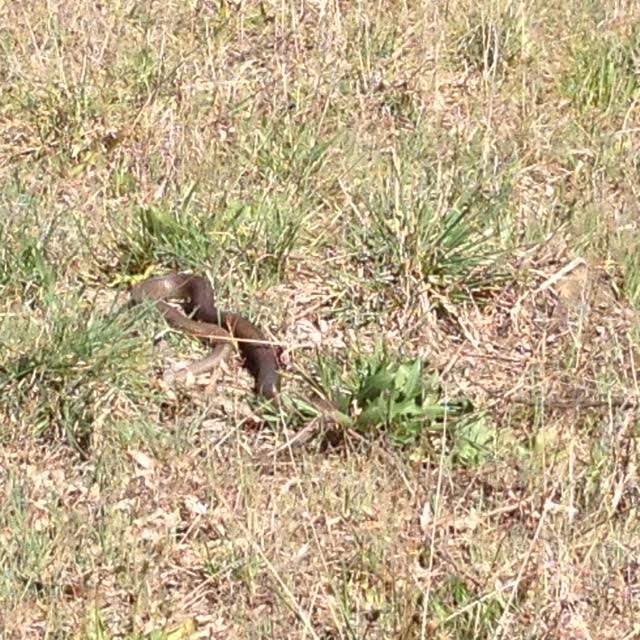
I just thought you might like to know that brown snakes are now active on Mt Rogers. I met this one in the grass as I was walking along the track beside the 2 tanks. It was the wide track adjacent to the tanks, not one of the narrow bush tracks

..............

On Monday 7 September, we had a working-bee opposite MIldenhall Place.
with John, Phil, Angharad, Ted & Kirsty tackling woody weeds. Photo below. 

Thank you all for a magnificent effort this morning. You morphed into an efficient team and accepted the rather haphazard-seeming challenge of walking & weeding.

Between us we despatched >100 Serrated tussock tussocks, caught up with briar roses, cotoneaster, firethorn and privet of various heights and complexities. Often this involved working in the depths of dead Cootamundra wattles. We took out smaller, non-flowering C. wattles.

Our rewards were good company, sharing with like-minds and an array of sightings....including White-eared Honeyeaters, Grey Fantails, Thornbills and their calls. There was a weird cluster of fungi, there were Early Nancy blooms and we began by checking out the Cryptandra patch with neighbouring Hardenbergia, Hop Bush and Kangaroo Grass.

The 'Telstra' ivy patch was revisited to be saved for another, specific effort. St Johns Wort was earmarked for detailed spraying as the rosettes are throughout good vegetation in one 4 m x 4 m patch.


Definitely one of the most productive working-bees  to those who know what's there and what's at stake....thank you! 

Rosemary