Next working bee, and what we've done recently

The next scheduled Mt Rogers working bee is on Monday 7th March. We’ll meet at Wickens Place, Fraser by 09.00am and return to the task of tackling weed species that will be dispersing their ripening seeds within the next few weeks. 

If able to volunteer then please bring secateurs and water to drink. 
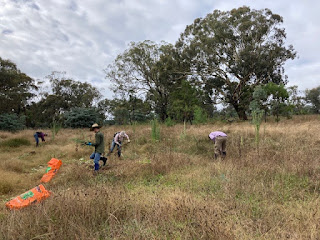
As you can see from the photo (immediately below) of Roger, Colette, Jennifer, Phil and hidden Ted at work on Sunday 27th, it’s a search and destroy mission for the target species shown in the next photo below:
 
in order, left - right: Fleabane, Verbascum (Mullein), Thistle and
Prickly Lettuce. 

We’ll have gloves, gaiters and other tools. 
The photo just above shows the value of gaiters. Each of these Paspalum seeds has enough hooks to cling to the threads of the fabric. This seed  dispersal method was the inspiration for Velcro many decades ago. 

Here’s the pile of St John’s Wort (photo below) that was pulled out of the grassland north of Jacob Place, Flynn a few weeks ago. Xtine is now putting the remains in their rubbish bin bit by bit... A really helpful contribution as this noxious weed needs to be deeply buried rather than go to a Green Waste recycling site. 

Jennifer is aiming to put up some mini-posters showing what the target species look like. The suburbs are as full of these weed species as the reserves are. They, and hundreds of annual weeds have thrived in the damp conditions from La Nina. 

Here are some methodologies for managing the current target species:

Pull St John’s Wort whilst the soil’s still damp and leave in dense piles on top of Phalaris, Paspalum grasses or other undesirable plants in full sun if possible. Some volunteers pile weeds up on the ‘bare' ground under eucalypts where the seeds are less likely to germinate.

Verbascum or Mullein: cut heads off and bag if there’s enough bags and the capacity to carry their weight out of the infestation area. Pile up untransportable heads in one exposed place. Pull plant out if the soil’s damp enough to allow this without causing hernias or back damage. Pile up stems in one or more places also on top of undesirable species. Rosettes of younger plants are daubed with herbicide. 

Thistles: cut off any flowerheads that are coloured-up/about to open for pollinators and bag these. Also cut and bag brown heads. Cut the rest of the flowering area of the plant into short lengths. Leave on the ground to 'cook' and then rot down.
Lop the plant close to the soil.

Prickly Lettuce: There’s so much of it that bagging the flowerheads is unrealistic. But cutting flowerheads off and then covering them with the weight and mass of the rest of the plant should prevent any seeds from blowing away. 
I also wondered abut getting some  sturdy black plastic bags and filling them with Prickly lettuce heads. Then leaving each bag on a patch of ferals to see if the PL rots and then dies by enclosed cooking. Need to retrieve the black plastic bags at some stage. 

Fleabane: Green and young plants are pullable at present and leave where they are. If flowering or seeding, cut and bag heads if possible. If not cut flower and seeding heads off, pile them in one place and pile the remains of the plants on top. Pulling up is best but unlike SJW they bring a clod of soil with them which brings light to other seeds in the disturbed soil. Holding down the soil with one foot whilst pulling helps leave half the soil clod in situ, Steve’s found. I’ve felt guilty for some recently when they have moss growing round them. Mosses and lichens are so essential for preventing soil washing or blowing away.   Cutting the Fleabane off at ground level will set the plant back but it’s likely to resprout. 

Mustard: Pull up the plants if soil’s damp enough and make dense piles of them on top of feral vegetation. TCCS staff did take six woolbags of Mustard away for us in 2020 and piles of SJW from Hall in 2022 but their ability to do this depends on other commitments. 

I hope your gardens are free of these invasive species.
Keep a lookout for clusters of privet and ivy seedlings growing under trees, shrubs and along fencelines.  They’re easy to pull out when young. The seedlings come from berries that birds feast on in others’ gardens  and poo into the reserves when they fly over or perch on trees. 

There’s no such thing as low maintenance gardening is there?
Thank you for all your diverse contributions to Landcare,

Rosemary


Mt Rogers news in mid-February 2022….mostly about Landcare activities

With the determined efforts of dozens of volunteers over the past 25 years Mount Rogers is relatively free of woody weeds such as privet, cotoneaster, firethorn, honeysuckle and hawthorn. Woody weeds come into the 65 hectare reserve as berries that birds have feasted on while in suburban gardens or the ACT’s green spaces on public land. Several infestations of Blackberry are constantly monitored. They and Chilean Needlegrass, Serrated Tussock and African Lovegrass attract assistance from TCCS* rangers and employed contractors.

Landcare volunteers at Mount Rogers are dispirited by the extent of weed growth due to the rains and the fact that the seeds of many species have germinated and grown after years of dormancy in the soil’s seedbanks. We are planning to continue the Bradley method of weeding where we work from the centre of each biodiverse section of the reserve cutting or  treating any species that are a threat to the biodiversity of the native plants and animals. https://www.aabr.org.au/learn/what-i-bush-regeneration/general-principles/the-bradley-method/  We also weed by concentrating on specific places, track sides and learning identifications by focusing on one weed species at a time.

Where the soil is damp most of these species pull out quite readily with steady but gentle effort with some species and especially Verbascum (also called Mullein) needing attention now. We cut the flowering heads off and bag them leaving the pulled, green stems and leaves to dry and then rot down and fertilise the soil. Later in the season we will dig out many rosettes of Verbascum leaves. The grey-green leaves are quite attractive and soft to touch.

The biodiversity in some sections of the reserve is an extraordinary contrast to the rest of the reserve even though the native wildflowers are often hidden by annual weeds and introduced grasses thriving on the rain events of the last nine months.

Grass species from other countries were brought to Australia in the days when few landholders or even “agriculture departments” understood the land and Australian soils and plants in the way Indigenous peoples did. They expected to succeed by transferring European farming methods to the very different landscapes of the ancient continent. The species were often introduced to fix specific problems such as erosion but without the insects and grazing animals that controlled plant numbers in their original regions, the new arrivals thrived to became invasive species that threatened the survival of native grasses and wildflowers.

The mowing operators have recently reached Mount Rogers again. They have an enormous job trying to keep up with the growth of African Lovegrass resulting from the regular rain events coming through the ACT. I expect it’s possible to find out from the ACT Government’s website how many hectares need mowing in the ACT but it’s many, many thousands. As you’ll have noticed, several different types of mowing machines are required.  I doubt if any are manufactured in Australia.

All through Sprummer individual Landcare volunteers have continued their observations, reporting and weeding efforts. St John’s Wort is a prime target because each plant can produce thousands of seeds and the plants also spread with sucker-like roots through the soil.

Ideally SJW, this very invasive species, needs to go to the tip to be deeply buried.

We have chosen to work on SJW now because, with the ground being still damp, the plants pull out with a determined, steady pull. Normally pulling causes the suckering roots to break off, a signal to the plant to respond by growing new plants from the broken root pieces.

The plants are more mature than those in photos with numerous capsules containing seeds maturing but not yet ready to be dispersed. There are several articles about SJW on ’the web’ one of which stated that one plant could produce 33,000 seeds. 

The seeds remain viable in the soil for 12 years which is why Mt Rogers has seen a rash of SJW patches through the reserve this sprummer in spite of the Landcare Group’s consistent action against the invasive species over a decade or two. 

Why work on only one weed? There are so many invasive species that have gone berserk with all the rain. We are concentrating on weeding near and outwards from Mt Rogers' best vegetation areas or on specific species that spread thousands of seeds. (Currently Thistles, Euphorbia, Fleabane, Verbascum, Mustard.) Ann has posted some photos in the new 'page' (right hand column of the screen) called
'2022 summer weeds gallery', on the blog site, 
mtrogerslandcare.blogspot.com 

Here is mustard, close up, 


and below is a view of the effects of mustard's yellow blooms on the Ginninderra Creek landscape beyond West Macgregor in 2020.


During a working bee on Monday 7th February Phil and I pulled up hundreds of St John’s Wort plants whilst Steve D returned to Bridget’s to repeat spot-spray an infestation of African Lovegrass there as we worked north of Jacob Place. The Sunday 23rd session saw three of us working on isolated plants north of the main carpark in Fraser. Ted walks daily with a wand to daub specific invasives as he comes across them. Each of our regular landcarers carries a pair of gloves whilst focussing on weed species they know as they walk on ’the hill’.

 The Mt Rogers Landcare Group has scheduled morning landcaring sessions twice a month:

1st Monday and the 4th Sunday. The meeting places vary according to the tasks that are prioritised each time.

As mentioned above our community members contribute numerous landcaring acts each time they are in the reserve. Observing nature, recording wildlife and plant species, welcoming newcomers, collecting rubbish when found, monitoring erosion run-offs, sharing enthusiasm for the reserve and its habitats.

Our group is one of over 25 energised communities determined to make a difference for wildlife, waterways and habitats in the Ngunawal land catchment area of Ginninderra Creek. The creek rises in Mulligans Flat making its way through its floodplain until water reaches the spectacular 40m waterfall in NSW at Parkwood, and the Murrumbidgee River beyond Macgregor. If you’d like a map of Ginninderra Catchment a new one was published in 2021.

The catchment’s Landcare and Parkcare groups come under the ‘umbrella’ of Ginninderra Catchment Group (GCG) based at Kippax. GCG provides ecological and land management advice and networking. We also have considerable operational and liaison support with other government agencies from *TCCS (Transport Canberra & City Services) volunteer co-ordinating staff.

There are other ways to contribute to nature’s health with volunteering opportunities through Frogwatch, Turtlewatch and Waterwatch. Their co-ordinators are also based at Kippax.

Contact the office by leaving a message on 6278 3309 or by emailing landcare@ginninderralandcare.org.au


Rosemary  10.02.22.

Convenor, Mt Rogers Landcare Group.

 6258 4724
or via the catchment group (as above: 
6278 3309
or by emailing landcare@ginninderralandcare.org.au)

Mt Rogers working bees January and early February 2022

 Greetings to Mt Rogers’ carers’ community as, in theory, a new year of twice-monthly Landcare activities begins.

We meet on the fourth Sunday and first Monday of each month with some variations caused by public holidays.

Therefore Sunday 23rd January and Monday 7th February are the dates.
We’ll meet at the Wickens Place, Fraser carpark on Sunday 23rd for a physically distanced chat and then have a walk and weed. 
The seven day forecast suggests 27 degrees for next Sunday so if it’s like today a 9am start will be feasible rather than 08.30. 


We’ll be targeting specific herbaceous weeds in the quality grassy woodland area north of the carpark. We’ll be able to give identification clues on the day. There are some to pull up and most of them will  need their flower-heads cut off and bagged to prevent their thousands of seeds maturing and dispersing. We’ll be able to give identification clues on the day so no prior knowledge is needed….we’ve all learned on the job. 
The Landcare group has tools, bags, gaiters and some gloves but if you’d like to bring your own (preferably water-proof) gloves, that’s fine. 
You won’t be surprised to read that the weeds and grasses are tall and there’s plenty of pollen and dust around. 

If you don’t feel comfortable joining in at this stage that’s understandable and “no worries”.
If you find or feel that your life has “moved on” and you no longer want to be on the email list please let me know. 

There still seem to be plenty of people taking walks or cycling around the main path. 
Today I did come across one big kangaroo but he elected to unconcernedly hop off giving me a wide berth but there were also many bird calls and numerous butterflies. 

In recent weeks a contractor has sprayed St John’s Wort (shown in flower in the photo) for us. He has sprayed huge numbers of the weed near Ginninderra Creek at Latham. It’s the most obvious invasive species around at the moment. Seeds of SJW can lie dormant in the soil for decades.

If you park at “Wickens” the most obvious invasive there is African Love Grass. It’ll be our turn to have this mown again soon no doubt. 


Thank you,

Rosemary

6258 4724

Mt Rogers on Monday December 6th, 9am - Euphorbia

Seven people made a difference in the reserve on Sunday 28th November. There were two apologies. Thank you Colette, Grace, Kerri-Ann, Phil, Roger and Ted. 

Three volunteers, wearing sturdy, waterproof gloves began an attack on a large and tall patch of Euphorbia on the eastern side of the reserve. Two waist-high piles of debris may be visible to observant walkers. 

Four of us spoiled the reproduction chances of flowering St John’s Wort (SJW) and Flatweed, bagging the flowers. 
We also pulled up Fleabane, and seedling SJW. 

Cotoneaster and Briar roses were cut and daubed, as were any emerging African Love Grass tussocks that Ted came across. 

Our results were less obvious as we walked across country to ‘Cryptandra patch’ treating the target invasive species as we walked. We achieved our aim of pulling out potential problems whilst the ground was damp enough, working outwards from the centre one of the best areas of Mt Rogers vegetation.
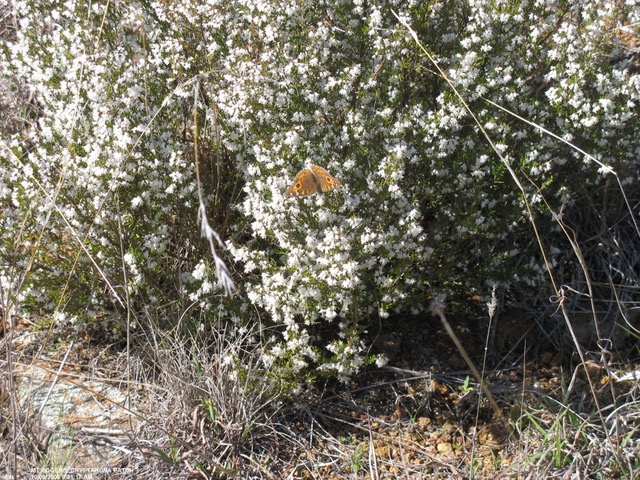
Cryptandra being visited by a Meadow Argus butterfly in September. 

On Monday 6th December we’ll revisit the Euphorbia by meeting at 09.00am where the easement between Spence and Melba brings people up to the reserve. I usually park in Hammett Place, Spence and walk up from there. 

Rosemary

Notes, and notice: Working bees on Sunday 28 November 9am & Monday 6 December

            In spite of occasional light showers as I walked through the reserve there was quite a flurry of bird activity including at least 5 Superb Parrots feeding from the flowering eucalypts. 

Here’s a reward for our volunteers' painstaking work against the rocks-dumper’s activities a month ago. There were four of these Fringed Lilies in bloom at ‘Bridget’s’ yesterday. 
All four plants were in the area landcarers cleared of garden debris. 

             Steve’s work against the African Lovegrass ‘near’ the red gate is remarkable

For our next two Mt Rogers sessions:
On Sunday 28th November the WORKING BEE volunteers will meet at Mildenhall Place, Fraser at 09.00am. 
Ted has highlighted a patch of Euphorbia to behead and bag and then pull out.
There are also Verbascum and Fleabane to attend too.
And detailed weeding near the Cryptandra patch all tasks we could walk and weed to if enough people are able to be there.
   Monday 6th December will be the final scheduled working-bee for 2021 and we’ll likely meet at Rechner Place, Flynn for another walk and weed session against weeds threatening the best quality areas in the south-west of the reserve. 
   Also 09.00 unless the temperatures hav significantly risen by the. 

   In each case please bring secateurs for beheading target species as I’m not sure how many pairs the Landcare group still has. 


THANK YOU!,

Rosemary

Mt Rogers working bee MONDAY 1 NOVEMBER

Dear Landcarers

In theory there are three more scheduled working bees before the end of 2021:

Monday 1st November
Sunday 28th November
Monday  December 6th

But there have been Covid 19 disruptions interfering with official sessions. 
Individuals have continued to make valued and low-key contributions all year including observing wildlife and finding weed patches needing attention. 

We held a weeding and rocks removal session on Sunday 24th October about which there will be more later.

On Monday 1st November a few of us will gather at 09.00hrs at the Wickens Place carpark  for a couple of hours. There’s a group of woody weeds Phil and Ted began working on Sunday 24th and we’ll also be on the look out for Paterson’s Curse.
The patch of Euphorbia between the  Bingley Crescent bus stop and Woodger Place has been reported to TCCS for urgent treatment before the seeds set. 


The flower-heads are greenish yellow. There are several species that have taken off with the rehydrated soils we had (until these windy days began to change things) 
It’s a popular novelty for gardens as it’s so unusual but the seeds readily disperse. Most species came from Europe originally.
If you have these plants always wear gloves when handling them as the poisonous, milky sap is caustic and can affect sensitive skin. 

For the 28th November we’ll have a separate notice and details of meeting place.


Rosemary,
Landcare group coordinator

Mt Rogers News, July 2021

Working bees
The Landcare Group’s next working bees are scheduled for Sunday 25th July and Monday 2nd August. We will be looking amongst the grasses for the soft-leaved Verbascum rosettes, having found they often dig out fairly easily and without too much soil disturbance now the ground is wet. We’ll meet at Schwarz Place’s eastern arm at 09.30 on 25th.

Bird sightings
Chris and I have seen Scarlet Robins on separate occasions. I’m not sure if the Robins' numbers are down for this winter spent on and around Mt Rogers. They move to the high country in early spring in order to nest there, but how many of these species that make those seasonal migrations were caught up in the devastating fires may still be unknown. A couple of weeks ago I saw a group of Choughs scrabbling away beside the trunk of an old tree east of the Notice Box. They are fun to watch and a bit like a flock of chooks with a definite sense of humour. Any time now there will be insectivorous bird activity in the flowering Cootamundra Wattles as the seek out any invertebrates that are amongst the yellow blossoms when the sun has warmed them up.  

Drainage
Rain events during this wet winter show how the water flows from Mt Rogers’ ridge-line both over the currently saturated ground and by seeping out from under vegetation. Phil’s run-offs are effectively channelling water away from cross-country paths and tracks and into the landscape. The water reaches Ginninderra Creek and eventually the Murrumbidgee River.

There are many streets in Flynn, Fraser, Spence and Melba where water is also draining down under or between houses. Perhaps some of these seepages are following ancient routes that would once have watered Grassy Woodland, ancient eucalypts, Native and Rocky grasslands and the shrubs and wildflowers of diverse pre-grazing habitats. Once in the streets’ drains the stormwater makes its way, piped, towards Ginninderra Creek. Waterwatch volunteers regularly test its quality, oxygen levels and temperature.

Pollution
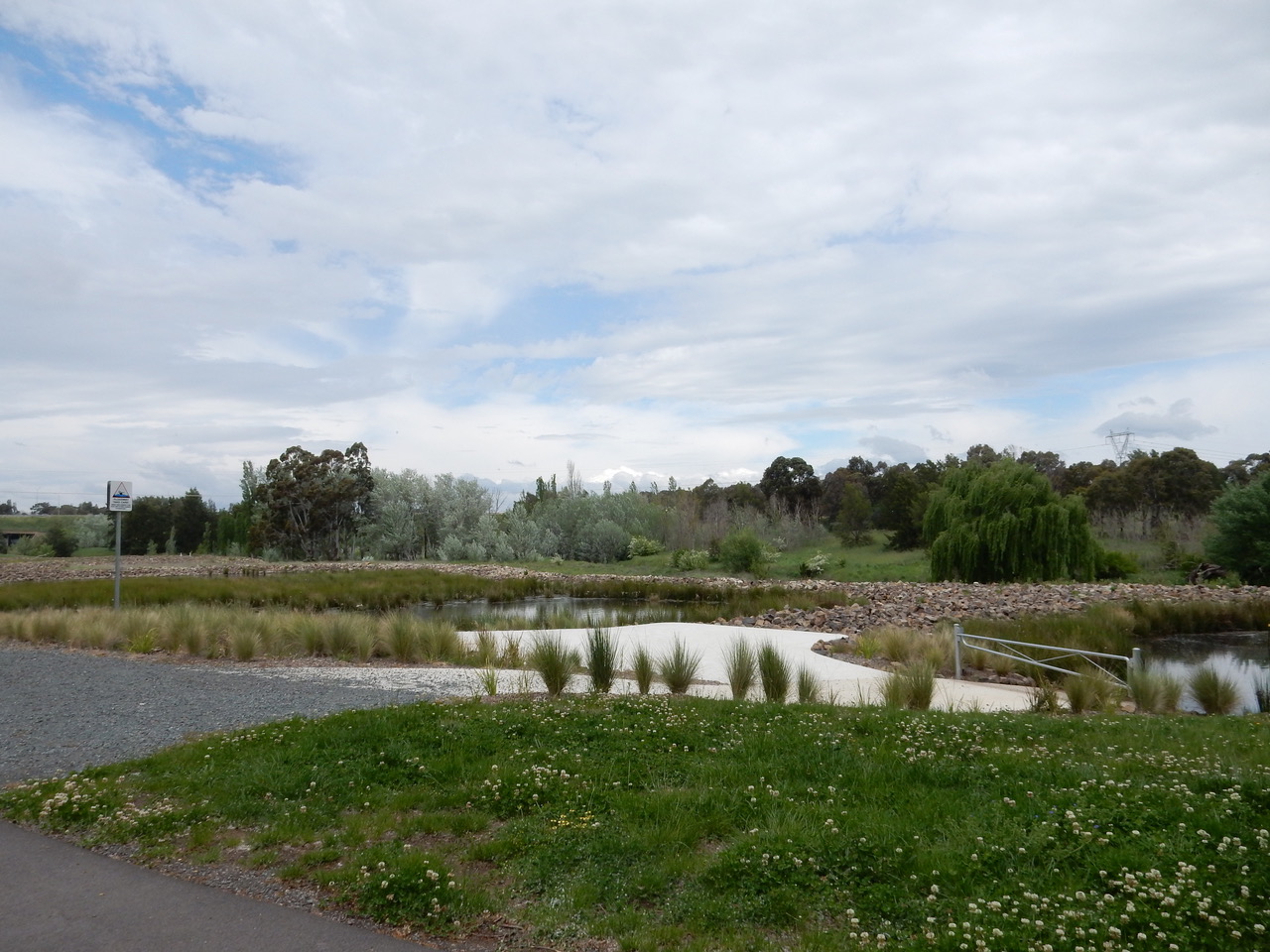
You’ll have driven past the ‘new’ rain-garden and wetlands at Florey, Evatt and Melba. Their plants act as filters taking chemicals and fine particles out of the stormwater from the suburbs’ drains before the water can enter the creek. In reality, all the stormwater drains that serve the suburbs need wetlands for filtration and to slow the water down. Fast flowing water causes the erosion of creek banks and, surely, downstream residents shouldn’t have to drink some of the fluids that leave our properties. See ‘H2OK: Keeping our Waterways healthy’ (at https://www.environment.act.gov.au/water/act-healthy-waterways/h2ok-keeping-our-waterways-healthy). 

  Evatt wetlands (left and below).

You can just see the Dam wall of Lake Ginninderra (i.e.Ginninderra Drive) at the extreme left of this photo.

I was watching a video about the River Wye that runs along the border between England and Wales, the other day. The river’s aquatic life is being killed by pollution from poultry and pig farms. Chemicals from the animals’ dung are washed into the Wye. There are regulations against this but insufficient resources to ensure compliance. Fertilisers from our gardens can have similarly toxic effects here, causing algal blooms in waterways.

From our gardens
Until this last year the Landcare volunteers were able to cautiously rejoice that the majority of ‘woody weed’ species could be seen growing in people’s gardens rather than in the Mt Rogers reserve. Once the drought broke and the seed bank in the rehydrated soil was stimulated, germination of these dormant seeds reached epic proportions. The numbers of annual and biennial weed plants reached trillions. Simultaneously native orchids, lilies, daisies astounded naturalists by appearing in large numbers or in places where they’d never been sighted before.

Berries
The trees and shrubs in gardens responded to the rain by producing millions of flowers that fed thousands of pollinators. Neighbours’ gardens and suburban laneways have berries of all colours; red, orange, black-purple, yellowy green, black and steel blue. Silvereyes, rosellas, currawongs, starlings, Indian Mynas, King Parrots, Bowerbirds – species both native and introduced – have feasted on these berries. Some bird species enhance seeds’ chances as the fruits make their way through digestive systems; others crush the seed beyond viability. There will be plenty of woody weed seedlings germinating from birds’ poo that is dropped into the reserve.


This was taken at Strathnairn but some in our Belconnen gardens look almost as inviting…..if you’re a bird!!

Fortunately, our Landcare community ‘rolls with the punches’ and we continue to enjoy each other’s company as we tackle weeds found in the high-quality vegetation areas. We work from the centre outwards, treating each invasive species methodically, based on shared expertise.   

Resources for Landcare & Ginninderra Catchment Group
On 24th June, Landcare volunteers received this message from Kat McGilp, who is the co-ordinator of Ginninderra Catchment Group.

 “It has recently been announced that the ACT Government's commitment to funding the three Catchment Groups for four years was confirmed by Minister Vassarotti in the Legislative Assembly early today.
The annual funding amounts are yet to be finalised, but it has been indicated that each catchment group will receive base funding, as well as Waterwatch and Frogwatch funding.” 

The vital news is that this funding seems to be assured for 4 years, meaning that the Catchment Groups’ ecology and land management-trained staff won’t have to spend hours seeking funding as the end of each financial year approaches. The commitment also indicates that there is some acknowledgement, in senior government ranks, that the landcaring we do on land that is not part of Canberra Nature Park’s reserve system is as important as the ‘parkcaring’ done by our volunteering ParkCare colleagues. ParkCare groups work just like we do in landcare, but they are on land in the Canberra Nature Parks – which have held higher conservation status for decades.

There are three catchment groups in the ACT. Each is an umbrella organisation advising and supporting the hundreds of volunteers who care for open spaces and waterways’ corridors that were initially mainly important for hosting utilities such as powerlines, roads, paths, sewer lines.

As people made time to explore beyond their homes and beyond the Canberra Nature Park (CNP) Hills and Ridges that frame Australia’s bush capital, they discovered remnant woodlands, residual Natural Temperate Grasslands, groups of boulders that protect native species, and views and creek-lines that revealed how Indigenous peoples had thrived on and travelled through Country for millennia prior to colonisation.

People from all walks of life became informal landcarers and citizen scientists, emerging with native species lists, weed lists, tools to tackle the most invasive species and, occasionally, with family projects to plant, build cubbies, make extra tracks and commemorate loved ones. They’d discovered local places where recording and conserving cultural, natural and inspirational treasures was as important as collecting data from the CNP gazetted reserves managed by the ACT Parks and Conservation Service.  

The ACT’s open spaces, smaller reserves and some riverine corridors are managed by land managers from TCCS (Transport Canberra & City Services). Ginninderra Catchment Group (GCG) supports volunteers working on the TCCS-managed lands where rainwater drains into Ginninderra Creek. There are TCCS rangers or Coordinators who provide liaison and links between GCG’s landcaring volunteers and the ACT Government’s processes and personnel.

For mobile fauna species and the plants whose pollen, spores and seeds they disperse it’s vital that areas of bush and complex habitats are of appropriate size and shape and that they’re not disconnected from other similar areas. For native animals and plants, consistent and respectful landcaring suited to their habitats’ needs will help them thrive and reach their potential. Healthy habitats and ecosystems bring enormous benefits to the reserves’ thousands of visitors and appreciators.   

‘Engaged communities for healthy habitats’ is GCG’s motto. There’s a brochure with a map of the catchment available through me (ph 6258 4724) or via GCG (ph 6278 3309 in office hours) if you’d like to see the extent of our habitat and find out where the Landcare Groups are located.

Rosemary.  21.07.21