Working bees 23 August and 7 September, and a swollen creek!


Here is a view of Mt Rogers in the misty, middle distance as taken from the Umbagong section of Ginninderra Creek at Latham on Sunday 9th August. 

We had some spectacular falls of rain in August 2004 when ‘records began’ on our newly acquired Rain Gauge but Latham folk reckoned this was the highest they’d seen a flood since 1974. 
So just in case you ever wondered where rain on the east, south and west side of Mt Rogers ended up here is one answer. And rain from the north of the ridgeline ends up in Gooroomon Ponds Creek. The confluence of the two creeks is beyond Dunlop and Jarramlee.

To return to the topic….our next working bees are scheduled for Sunday 23rd August and Monday 7th September. Let’s aim for a 09.30am start. 

On Sunday 23rd we’ll meet near the Flynn Playground off Rechner Place and mostly be using hand weeders to dig out the Flatweed and other invasive herbaceous plants that threaten the area near Rechner which is richly biodiverse. 

There’s no need to KNOW what the target weeds look like as we’ll be showing you plenty of examples. 

We’ll see how we go for a venue for Monday 7th but you’ll have noticed that there’s no shortage of Capeweed just waiting to begin flowering….good for the bees and teaching children about daisy chains but the seeds will top up the seed bank for future years on Mt Rogers and around the suburbs. 

Thanks for all you do, in diverse ways, for Mt Rogers,
Rosemary

MOUNT ROGERS NEWS Mid-July 2020

Earlier this afternoon I opened an email from Elan saying: 
Just wanted to let you know I was very rudely abused by a man walking two little dogs on leash.  He yelled at me saying Ringo should be on leash.  When I told him it is an off leash area he said it is not because it is not sign posted.  Ringo was nowhere near his dogs.” 

I was spurred into finalising the wording below, to which several of you contributed several months ago. I will send this off, asking Domestic Animal Services for ‘dog behaviour’ – OFF LEASH signs.

“Welcome to Mt Rogers

Mt Rogers is a dog off-lead area where all dogs under control of their handlers are welcome.

Please make sure your dog is either under good voice-control or on-lead if you have trouble recalling your dog. 

If your dog harms another animal or person, you could face legal action.

Pick up any dog faeces left by your dog and put it in the bin provided at Wickens Place or take it home with you.

Dog poo bags are available near the bin at the car park for those who forget the legal requirement to carry poo bags.

Because this is an off-lead area, any walkers who are nervous around dogs, or do not like dogs, may prefer to walk in places where dogs are not allowed off leash.

Mt Rogers is shared by walkers without dogs, and naturalists, joggers and cyclists, so consideration for others is always appreciated. Cyclists need to be aware of keeping their speed low since dogs and children are unpredictable.

Please respect Mt Rogers reserve. Its habitats, native animals and plants are protected by law for the well-being of all.

Mt Rogers Landcare volunteers”.

Signs explaining that Mt Rogers reserve is an OFF-LEASH area were ‘promised’ after the 2014 debacle of our having to spend hours of submission writing defending the off-leash status against the perceptions of ACT government ecologists.

I met several late-afternoon dog-walkers as I cable-tied the signs at the carpark. One lady said she was unnerved for a week after being berated for having her dog on a leash when Mt Rogers is off-leash.

Over the years there have been horror stories of attacks by dogs off- and on-leash: of kangaroos being chased, of people being knocked over by boisterous dogs, and of the huge vet bills that have been incurred by members of our community. The increased numbers of newcomers to Mt Rogers and all open spaces, since Covid19 altered people’s exercise and outdoor habits, has been remarkable. It is small comfort to regularly hear how much the visitors enjoy the spaces they have discovered if there are such upsetting results when people have more time to spend in areas treasured by the locals. 

Claire reported three youths on pee-wee motorcycles herding kangaroos eastward in their habitat alongside Kuringa Drive on Friday 17th. Others have dug up soil, rocks and native grasses north of the Second Summit to increase the adrenaline rush from their bike track towards the telecom tower.

New bike track works from Second summit.

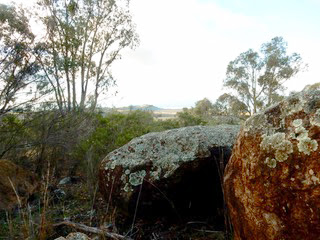
If only these magnificent lichen-covered boulders could tell their story
and how the view to One Tree Hill has changed in 200 years! 

Technicians have been working at the tower, and the crane was present on Friday - it was visible as I returned from Hall. Apparently the strength of the tower is to be increased by the pole that was inserted by the crane.

As a result of Angharad reporting that a vehicle had been driven over wire fencing, rocks have been placed along the fenceline augmenting the boulders that went in several years ago. The rocks look more natural and will keep some vehicles out, though not motorcycles.
Phone Crime Stoppers 1800 333 000 or the police 131 444 depending on the severity of the incident but always consider your own safety first even if considering taking photos.

We may need to also consider safety from rogue magpies soon. Many people are reporting pre-breeding and breeding activities observed in a range of species around the ACT. I have several of those Swooping Bird signs in the garage if you need them for somewhere where you walk. Access Canberra usually actions reports of magpies rapidly;
phone 13 22 81.

We’ve had two well attended working-bees recently concentrating on the green herbaceous weeds that have germinated as a result of the rain reaching the species’ seed banks. Mustard, Prickly Lettuce, Fumitory, Cranesbill, Wild Oats, Capeweed, Paterson’s Curse and wild oats have turned the drought-affected areas lush. There are swathes of Plantain and numerous Verbascum in places, and scattered Flatweed seedlings. Some Mallow plants are huge, taller than the weeders from some reports. Dandelions are in flower.

We’ll be continuing work against these introduced species for our next working bees on
Sunday 26th July and Monday 3rd August
also taking out any woody invasives we come across as we wander and weed.
Meet at Wickens Place carpark on each day at 09.30.

Jesse has been taking photos of Mt Rogers plants, and reporting some he didn’t know to Canberra Nature Map and creating a photographic species list as a herbarium. Ted has continued to carry and apply a weed wand when he’s on his daily walks and Phil has drawn up plans for erosion mitigation…newcomers during Covid19 don’t know about walking and riding bikes along the contours to reduce erosion of the thin soils.

The Ginninderra Catchment Group has a new Co-ordinator - Kat McGilp. Kat and the Group are working on a submission against a Defence Housing plan to build houses too close to the Natural Temperate Grasslands (NTG) on the one-time Naval Transmission Station at Lawson. Such NTG are critically endangered in southern Australia, and it’s another theft of habitat from native wildlife both rare and everyday species. 

Rosemary

Convenor, Mt Rogers Landcare Group. 6258 4724

Dog-poo-bag dispenser and other progress, July 2020


Thanks to Allan McLean of TCCS who responded to a request for a dispenser for dog poo bags we now have both a dispenser and a bin at the Wickens Place carpark entry area (as in the photo below). 


Mick Lee, of TCCS’s depot at Charnwood organised the crews for the dispenser’s installation. At one stage there was also talk of a second dispenser location near the Schwarz Place entry but we’ll wait and see. 
Mt Rogers folk who keep the place litter-free will be able, I assume, to put your daily collections into this bin rather than take the bags of litter home. 
The ACT Litter patrol will continue regular, weekly patrolling of Wickens Place.

Two sections of the wire fencing have been deliberately flattened by vehicles. We have previously shown TCCS Operations team personnel the easily penetrated nature of the remaining fencing but having more boulders installed wasn’t feasible then. 
When Mick phoned about the latest fencing breaches I suggested that boulders were the best solution for vehicles even though they still allowed motorbikes through in the Wickens Place area.

Today Mick and TCCS Operations colleagues have been on site to assess the Wickens fencing situation. Eventually the wire fencing will be replaced with some boulders in the SW area where some boulders are already on that fenceline. Today I took the photo below, surprised to find those smaller rocks there. Perhaps a bobcat is on its way to position them.


 Mick proposes TCCS cementing bollards in round the edges of the carpark area to prevent vehicles driving into the reserve. This would include bollards at the first-reported fenceline nearest the ’swing gate’, I understand.

Full marks to Allan and Mick and his crews for turning our observations into restoration action. 

Rosemary
Mt Rogers Landcare Convenor
8 July 2020

MT Rogers in May 2020; the surprising weather continues


At the beginning of the Covid 19 restrictions the Landcare Group was informed that we could not hold organised landcaring events for the duration. On 13th May we were told that restrictions on Landcare activities had been eased provided there were not more than ten volunteers participating. We’re considering resuming official working-bees on Sunday 24th May and Monday 1st June. There’s no shortage of observation and weeding opportunities!  For example, do you recognise this rosette? (photo below)

Phil, Ted and Richard continued to spend hours walking across and observing Mt Rogers as their daily exercise routines. They’ve set themselves targets relating to specific weed species that have benefited from the sequence of warmth, rain events and sunny days. ALG,
Mustard, Prickly Lettuce, Verbascum, Fumitory, Capeweed, Plantain, Wild Oats are among the species making the reserve lush and green for the first time in years. The catch is that nothing eats the greenery tho pollinators visit blooms.
All round the region landcaring has continued with volunteers keeping their physical distances just as regular walkers on Mt Rogers have. Every time I’ve been there the track has been busy and most people have had smiles and greetings ready!
Congratulations to Mt Rogers’ regulars who were respecting the track repair project we began down from the Trig Point. Landcare volunteers’ dismay, anger, frustration have surfaced when Covid19 newcomers who don’t understand have undone the placement of branches on the Summit track descending east. They are determined to have their biking and running fun and test their challenges without any thought as to erosion’s effects on the terrain they are pummelling.
Rock-rolling has also been evident in reserves. Rocks are also moved as reptiles are sought. If only these people had the same awareness as the Mt Rogers’ caring community. Thousands of invertebrates are exposed by these actions. Lichens on the rocks are denied the cooler aspects most of them need to flourish and to exhibit the delicate collage of colours that autumn’s dampness stimulates. Lichens are a symbiotic relationship between a fungus and an alga.
Would anyone like to make a photographic collage of the Fungi species they’ve seen taking advantage of the warmth and dampness of recent weeks? Tall, tiny, puff-balls, Earth Stars, Slime Moulds, and the forests of sporangia from Lichens’ symbiotic partnerships. Bright orange bracket fungi hide under the tree trunks from which they’re recycling nutrients.
FungiMap can help with identifying what we find. Have you contemplated the hydraulic force needed to push through soil, asphalt and timber?
ABC Radio National’s Science Show led me to The Magic of Mushrooms. Listeners are introduced to a suite of research programs that instil optimism from the capabilities of the mycelia found throughout the Fungal Kingdom’s incredible diversity. From there I tried You Tube’s: The Fungus Whisperer aka Alison Pouliot who explains the essential nature of fungi in all aspects of our lives in an engaging and exciting way.


Kerri-Ann and Michael surprised a Brown Snake on 18th April and took some spectacular photographs (above). By then we’d had a few cooler nights. Possibly the snake felt threatened by not being warm enough to react to their being near it by sliding away unseen. To confirm the pale-bellied snake’s identity Kerri-Ann sent the images to Canberra Nature Map where volunteer moderators agreed it was a Brown Snake. Anyone can send GPS-based images to CNM especially if the sighting is of an unusual organism. 

Mt Rogers has been visited by citizen science photographers in recent months resulting in an array of invertebrates being recorded as Mt Rogers’ residents. This is of great benefit to us as evidence of its being a place of biodiversity and conservation value on a par with the Canberra Nature P reserves that were gazetted as such. Other ways to go closer to identifying birds include the Canberra Birds’ or Canberra Nature Map’s websites.
Covid 19 has given many people time to be out and about with the weather often helping to encourage explorations busy lives couldn’t prioritise. More people have been out on Mt Rogers and appreciative. Some exceptional cubbies and tepees (e.g. photo below) have been created to, we hope, indicate that others feel a sense of belonging, as sense of home and even comfort in accepting the challenges of design, building and taking time just to BE in a special place surrounded by nature.
Angharad and Bob came across a Mixed Feeding Flock of small birds including several Jacky Winters. This sighting and a later one by Barbara is a major coup for Mt Rogers as Jacky Winters are rarely seen these days.  
I hope you’ve all seen or heard the Yellow-Tailed Black Cockatoos during their visits or flying over our suburbs seeking cones and the grubs they hear under trees’ bark. There’s plenty of evidence of them using their strong beaks on a range of different trees’ trunks. It’s incredible to compare the cockatoos’ hearing with ours. They, and the Magpies I’m currently reading about, can hear the larvaes’ minute sounds before their beaks go into action.
And in The Guardian there's an important article on Flying Foxes, titled 'Fear of flying foxes: coronavirus is topping off a bad year for Australia's bats'. I don't know nearly enough about these incredibly important mammals but occasionally see them fly around the streetlights seeking insects attracted to the light. 
Native Sorghum has recently been found, flowering, in two places where I thought the clusters had died. They seem to have responded to the Hazard Reduction Burns in each case, though the rain sequences may have induced late flowering. I took the photo below at The Pinnacle some years ago; it shows the grass flowers' colours when fully out and in summer warmth. The Pinnacle is another of the special habitats we share with thousands of other species. 

Sorghum in flower on The Pinnacle, 13.12.13. 
This view is now altered forever by the Whitlam and Denman Prospect developments in the distance.


Grasses flowering west of Snow Gum corner now, on The Pinnacle. 

Being outdoors has become trendy but our community is observant too! 

Rosemary, Convenor, Mt Rogers Landcare Group.    6258 4724.

Mount Rogers in March 2020


Today, for the first time in ages I walked Mt Rogers whilst the dog ran himself into the ground exploring in, I assumed, a snake-free opportunity. 
The rain induced growth is both fascinating and amazing for plants and fungi. 

I went up to the summit via a zig-zagging route and pulling up a few weeds along the way.


I was keen to check out the rain's effects on the erosion measures we Landcarers put in place on 23rd February and 2nd March.
Eleven of us were there on 23rd to share solutions and begin the process of reducing the rainwater’s flow downhill. We put branches along the edges of the eroded path down from the Trig point. On 2nd we augmented that procedure by adding rocky-weirs into the track-gully itself to slow the water and also trap any debris. Water seems to have gone sideways across the reserve through new and older run-offs. 


Jennifer created several signs based on wording from Phil’s research. Sarah brought expertise in landscape repair from her own experiences in the region and David Tongway’s even broader Landscape Function Analysis. 

Julie and Jemima filled half a bucket with broken glass from around the Trig Point. Richard continued collecting on 2nd and later filled his own bucket with more pieces. 
We have therefore done our bit for the official Clean Up Day…but apart from the mindless bottle-smashing on the Summit you all keep Mt Rogers so clear of rubbish every day that an official event hasn’t been necessary for 2 decades. 

Today I noticed people have begun to use or recreate a track to the south of the Trig. At the moment they are going across the grassy slope and gradually going down towards the south-eastern section of the gravel path. This is great route because the grasses there are mostly introduced species; we won’t be losing any native vegetation. 

More on the erosion efforts and why, where, when, how and what…in the Page added to this blog site, at top right, called 'Mt Rogers Erosion project Notes 2020'.

Ted recorded that a contractor has been spraying African Lovegrass (ALG) between the main path and houses’ back fences in the past week (10th to 15th). Ted has joined Steve by daubing isolated ALG tussocks deeper into the reserve and alongside the cross-country tracks. Steve has persisted with spraying the ALG to the north of the Wickens Place Carpark as it threatens the most biodiverse part of the whole 65ha reserve.  

On Saturday 22nd February Chris sent two phone-photos of a Frogmouth he’d found in Keane Place. Later and after Angharad had checked the bird I took it to the Belconnen Veterinary Hospital in Weetangera. When I emailed on Monday I found out that it wasn’t seriously injured so euthanising was avoided. We had sound advice from ACT Wildlife 0432 300 033 who suggested the Belconnen vet and Gungahlin Veterinary Hospital would handle wildlife. 
The Frogmouth was collected from the vet’s by an ACT Wildlife carer. After it has recovered it will be returned to Mt Rogers as a result of the form I filled in. A good surprise for its mate as they mate for life I believe.

I noticed a couple reading the Information Sheets on the seats today. Another thank you for Morgan and family for reinstalling these and in such a sturdy way.

The next working bees are scheduled for Sunday 22nd March and Monday 6th April.

We’ll be in touch again briefly to notify about the details.

Thanks for the community you have created and maintained on Mt Rogers,

Rosemary

Mt Rogers’ first newsletter in the new decade, 2020


Heavy machinery has been used to clear shrubs and understorey in the land north of Fraser and parallel to Kuringa Drive. In spite of the invasive weeds that have taken advantage of this grassy woodland remnant it was a linear haven and connectivity space for native fauna. Kangaroos and birds paused and foraged there between Mt Rogers and the broad open spaces of CSIRO land, Hall’s habitats and the grazing country around Gungahlin.
We’ve heard that the clearing is to protect assets and lives from potential fires.

When we despair at the devastation the 2019 – 2020 summer has wrought in Australia here is a link that may bring some hope.
It’s also an example of the thousands of effective, grassroots actions that are not newsworthy enough for the majority of media outlets.
And, with case studies in our region, follow another line of visionary practice through regenerative agriculture and rehydrating soils: the Mulloon Institute, Martin Royds and Charles Massy … though I’m not sure how they have been affected by fires in the Braidwood area.

And close to the subject of fires, there was post from Steve Taylor, Invasive Species Officer, on the ACT and SE NSW Invasive Plants Facebook page. He said that the fire that swept rapidly towards Queanbeyan from near the airport was burning large areas of African Love Grass that his weeds unit had mapped.

Mt Rogers’ folk were among the first to respond to the humane logic of putting water out for wildlife. They included partially submerged sticks or flat rocks in the water for animals with short legs.

Maybe you’ve noticed unusual visitors in your gardens?
Some young and later adult Eastern Spinebills had a great time on an orange-flowered Grevillea. They behave like L-plated Humming Birds at times hovering whilst protruding their tongues into the flowers’ tubular petals. I suspect they may be ‘high’ on the nectar’s sugary content but then burn off energy chasing each other around. Our Correas are flowering now and the Spinebills visit them.
Twice now we’ve heard a Koel fledgling calling from shrubs near the back fence.
I watched out for the cuckoo chick’s host and saw it being fed by a Red Wattlebird. The adult Koels are still heard from time to time. I wonder what benefits come from having other birds incubate and raise cuckoos’ chicks?
Less appealing, we’ve also had flocks of Indian Mynas and Starlings around due to two-doors-down’s indiscriminate feeding of birds. Anyone been trapping Mynas recently? With food so scarce we can’t afford poachers!

Lyndon reported “3 Straw-necked Ibis on Mt. Rogers, Flynn, at 5 pm today. My first ever sighting of these birds on Mt. Rogers in the 43 years I have lived here.” We’ve seen the Ibis flying over Mt Rogers and on school ovals but never digging amongst the reserve’s grass.
Barbara photographed Yellow-tailed Black Cockatoos in their Bainton Crescent garden also on 6th January. It’s early, I’d suggest, for the big cockatoos to be back in Canberra foraging.

I finally ‘got round to’ sending reports of my Echidna sightings to Echidna Watch on Kangaroo Island. Peggy Rismiller and her team have been studying these iconic monotremes for many decades and welcome sighting reports from our region. I went back through photos and filled out forms for each memorable event. The Pelican Lagoon Research Centre has a website but the online reporting facility isn’t working at the moment. Thank you for the several Mt Rogers sightings you’ve mentioned to me. Let’s ensure the Mt Rogers’ echidnas are on Peggy’s maps. Sightings can also be sent to Canberra Nature Map.

Far less happy are the reports of dead trees on Mt Rogers. Each of our gardens shows similar effects of the drought and the desperate lack of soil moisture that is even killing long-established species. We have had some rain but the soil has been hydrophobic for months, preventing rain from soaking into the soil to restore thirsty plants if it falls too quickly.

Ted commented that Mt Rogers has been “in survival mode”. It will be interesting to see which invasive species are the first to spring back to being green after the rain we’ve had. Mustard, Prickly Lettuce and Skeleton weed are three species I’ve seen most frequently green and flowering with a background of beige on pulverised nature strip grass.

Phil seems cautiously optimistic about the after-the-rain-state of the erosion run-offs he tirelessly creates and monitors on Mt Rogers. The main path would be much more uneven were it not for Phil’s efforts. The ACT budget would be redder without the thousands of volunteer hours people contribute to Landcaring and the hundreds of other ways volunteers support the communities they believe in.

We will resume our customary 4th Sunday and 1st Monday working bee sessions on Monday February 3rd. Angharad, Ted and Phil have already contributed activity suggestions based on their regular walks and the observations they’ve made. Thanks to feedback from them, we’ll meet at the Wickens Place carpark at 08.30am unless anyone’s forecast suggests it will be cooler than Friday 31st’s 39 degrees.
If there is a Total Fire Ban or the forecast is for temperatures above 35 degrees the working bee will be cancelled. In December we created a coffee-based planning meeting out of the cancelled Monday working bee. So a pleasant precedent has been set!

A revised introduction to Mt Rogers is now on the Ginninderra Catchment Group’s website, as our Landcare Group’s volunteering happens in the catchment of Ginninderra Creek.
Thanks again to Ann who diligently updates the Mt Rogers blog: mtrogerslandcare.blogspot.com for us.

Rosemary 25.01.20. 6258 4724

A late November 2019 working bee


We had a working bee at “Bridget’s” (the section of Mt Rogers that was 'Hazard Reduction Burnt' in April 2019)  and the bush to the north of the carpark area at Wickens Place, Fraser.

Our 08.30 start was a precaution against the day heating up, but cloud cover didn’t clear until we were home again. Our rewards for another eight hours of volunteering were that working conditions were ideal; the cool start being enjoyed by a score or more of other Mt Rogers people walking along the track.

Before we even began we had fly-pasts from at least five Superb parrots. Angharad began seeing a pair of Superbs on 14th November.

Angharad, Phil and Ted were apologies as they had other calls on their time for Sunday 24th.
It was great to welcome Jemima and Ivan back to the workforce from unavailability through UniCan studies and a sore shoulder respectively. 
Chris came over to return pairs of gaiters he and Margaret had borrowed for more active landcaring. They’re part of the team that collects rubbish on their daily walks. Morgan and her family have replaced the information sheets around Mt Rogers’ seats with more robust editions.

The essence of Landcare volunteering is that we offer and share skills as and when we can, appreciating the valued contribution of those who visit Mt Rogers and share their appreciation for this special place.

Angharad has been watching the Frogmouth family she found once they’d established their 2019 nest. The photos are gorgeous. Here is one of them. 
Ivan noted seeing Frogmouths in their Spence garden. This is possibly another pair as the 65 hectare size of the reserve could support 4–6 families because of the flowers, shrubs and therefore insects we have in nearby gardens.
Chris reported that Margaret had found evidence of Satin Bowerbirds using the reserve’s shrubby cover for a bower site. Bowerbirds are another species that enjoys visiting and sometimes raiding gardens for fruit and vegetable delicacies. 

We walked over to “Bridget’s” (named after Bridget who used to live in Woodger Place and walked Mt Rogers regularly in those days) to check on the African Lovegrass (ALG) growth that threatens the biodiversity of the bush there.
We did a circuit of the area, digging or pulling out Paterson’s Curse, daubing isolated ALG tussocks, Mustard, Skeleton Weed and Flatweed.

As we worked we learned and shared stories, experiences and information.
The Paterson’s Curse we found in this area is its Boraginaceae family relative, Viper’s Bugloss. There are real Paterson’s Curse plants elsewhere in the reserve but not as many as there once were.
The ALG infestation is recovering well from the Hazard Reduction Burn although the isolated tussocks are more affected by the dryness than those nearest the footpath.

There were scattered Flatweed plants; worth digging up so they didn’t take more moisture from the recovering native vegetation.
The Flatweed flowers are dandelion-yellow. They’re held aloft on long, thin stalks to attract pollinators whereas Dandelions’ stalks are hollow and exude white sap when cut.
Each Flatweed flowerhead is a composite of 50–70 individual florets which, when pollinated, produce 50–70 seeds to be blown away on the wind … as infested, unkempt nature strips show all around the ACT and beyond.

Farther away from the path and carpark we were treated to an almost-swathe of yellow native daisies: Chrysocephalum apiculatum & Chrysocephalum semipapposum. Both have clusters of pom-pom flowers, the first being a ground cover species.

There were a few native St John’s Wort plants just beginning to flower.

Greenish-beige patches of native Plantain were affected by the dryness. We dug out a few of the introduced plantain plants and tried to tell the difference from their leaves and flowers. 
Bluebells, Convolvulus and native grasses were more cryptic. A Tricoryne lily would wait until the sun was really shining before opening its yellow petals. These natives each have a robust root system to withstand the cool burns from April.
Many of the Grevillea bushes had white scale infestations on them.
Closer to Woodger Place were several regenerating Indigofera adesmiifolia bushes and the offspring they’d produced over the years.

The huge ALG patch was daunting but we dug out a score of the tussocks. We cut off flowers on some of the isolated African Lovegrass plants and bagged them.
Too much digging would make the soil prone to erosion.

On the way back to the cars we couldn’t resist doing some cosmetic landcaring by digging out the large and smaller Mustard plants growing amongst the carpark’s mown ALG. This was a salute to Phil who’s dug out hundreds of Mustard plants in the bush behind Schwarz Place. We filled 4–5 bags with Mustard and Prickly Lettuce plants earlier in the year and TCCS were quite prompt in taking the bags away to be mulched into compost.

We shared stories of poorly managed “dogs off leash”, the few irresponsible owners who brought their dogs to Mt Rogers regardless of others’ and wildlife’s safety and others whose dogs caused attacks within the suburbs. We agreed on, and Marion later confirmed, appreciation for the Dog Compliance Rangers who have visited Mt Rogers and got to know several of the law-abiding Mt Rogers community in conversation … and dealt with deviants.

Today I met the man who brings mince to the Mt Rogers magpies. Let’s hope he uses preservative-free mince.
Most Mt Rogers people would have shallow bird baths for the birds that visit their gardens. We have a broken piece of terracotta pot in the saucer-shaped dish so bees and small birds can reach the water without risk of falling in. 

Mt Rogers and so many gardens already have a February–March look. 
Let’s hope the next edition of Our Canberra has advice on how and when to water for those new to our region and to gardening.

Rosemary
24 November 2019